)

Tuesday, May 30, 2023

Credit: Breakthrough Listen / Danielle Futselaar
May 30, 2023, Mountain View, CA – Akshay Suresh, a graduate student at Cornell University, spearheads an extraordinary scientific endeavor -- a groundbreaking mission to uncover periodic signals emanating from the core of the Milky Way called the Breakthrough Listen Investigation for Periodic Spectral Signals (BLIPSS). Such repetitive patterns could be the key to unlocking the mysteries of extraterrestrial intelligence in our galaxy. Suresh and his co-authors detail the project’s results thus far in a paper accepted for publication in the Astronomical Journal, “A 4–8 GHz Galactic Center Search for Periodic Technosignatures.”
BLIPSS is a collaboration between Cornell University, the SETI Institute, and Breakthrough Listen. By directing their focus towards the central region of the Milky Way, with its dense congregation of stars and possibly habitable exoplanets, the BLIPSS team amplifies the odds of capturing compelling evidence of extraterrestrial technology. If an alien civilization wanted to communicate with other civilizations throughout the Milky Way, the galaxy’s core holds potential as a strategic site for a beacon.
“BLIPSS showcases the cutting-edge potential of software as a science multiplier for SETI,” said Suresh.
SETI Institute Astronomer Dr. Vishal Gajjar is one of Suresh’s advisors on the project. “Until now, radio SETI has primarily dedicated its efforts to the search for continuous signals,” said Gajjar. “Our study sheds light on the remarkable energy efficiency of a train of pulses as a means of interstellar communication across vast distances. Notably, this study marks the first-ever comprehensive endeavor to conduct in-depth searches for these signals.”
The team began by testing their algorithm on known pulsars, successfully detecting the expected periodic emissions. Subsequently, they turned their attention to a dataset of scans of the Galactic Center captured by the Breakthrough Listen instrument on the Green Bank Telescope (GBT) in West Virginia. Unlike pulsars, which emit signals across a broad range of radio frequencies, BLIPSS narrowed its search to repeating signals within a narrower frequency range—covering less than a tenth of the width of an average FM radio station.
Dr. Steve Croft, the Breakthrough Listen Project Scientist for GBT and Adjunct Senior Astronomer at the SETI Institute, highlighted the significance of this approach, as it combines narrow bandwidths with periodic patterns that could signify deliberate technological activities by intelligent civilizations. Suresh’s technique presents a novel methodology to sift through this metaphorical haystack, enabling the team to identify tantalizing evidence of advanced extraterrestrial life forms.
A PDF of the paper (accepted for publication in the Astronomical Journal), links to the datasets examined, and an artist’s conception of an artificial periodic transmitter are available at https://seti.berkeley.edu/blipss/.
About the SETI Institute
Founded in 1984, the SETI Institute is a non-profit, multi-disciplinary research and education organization whose mission is to lead humanity’s quest to understand the origins and prevalence of life and intelligence in the Universe and to share that knowledge with the world. Its research encompasses the physical and biological sciences and leverages expertise in data analytics, machine learning and advanced signal detection technologies. The SETI Institute is a distinguished research partner for industry, academia and government agencies, including NASA and NSF.
Contact information
Rebecca McDonald
Director of Communications
SETI Institute
[email protected]
Breakthrough Listen is a scientific program searching for evidence of technological life in the Universe. It aims to survey one million nearby stars, the entire galactic plane and 100 nearby galaxies at a wide range of radio and optical bands. Additional information: breakthroughinitiatives.org.
The Breakthrough Initiatives are a suite of scientific and technological programs investigating the fundamental questions of life in the Universe. The Breakthrough Initiatives are funded by the Breakthrough Foundation established by Yuri and Julia Milner. Additional information about Yuri: yurimilner.com.







News
Related News
Jun 9, 2026
Disclosure Needs Data
#SkyMapper #Franck Marchis #SETI #citizen science
Jun 8, 2026
The Sounds of Intelligence: A Conversation with 2026 Drake Award Recipient Lori Marino
#Blog #Drake Awards #Lori Marino #SETI
Jun 5, 2026
Beyond Disclosure Day: The Real-World Protocols
#Press Releases #SETI #Astronomy #Bill Diamond #SETI Institute
Jun 4, 2026
SETI Institute In the News: May Roundup 2026
#SETI Institute in the News #SETI Institute #Community #Solar System #Matija Ćuk #Neptune #SETI #Bill Diamond #UAPs #Drake Awards #Lori Marino #Matthew Tiscareno #Outreach #Exoplanets #Carl Sagan Center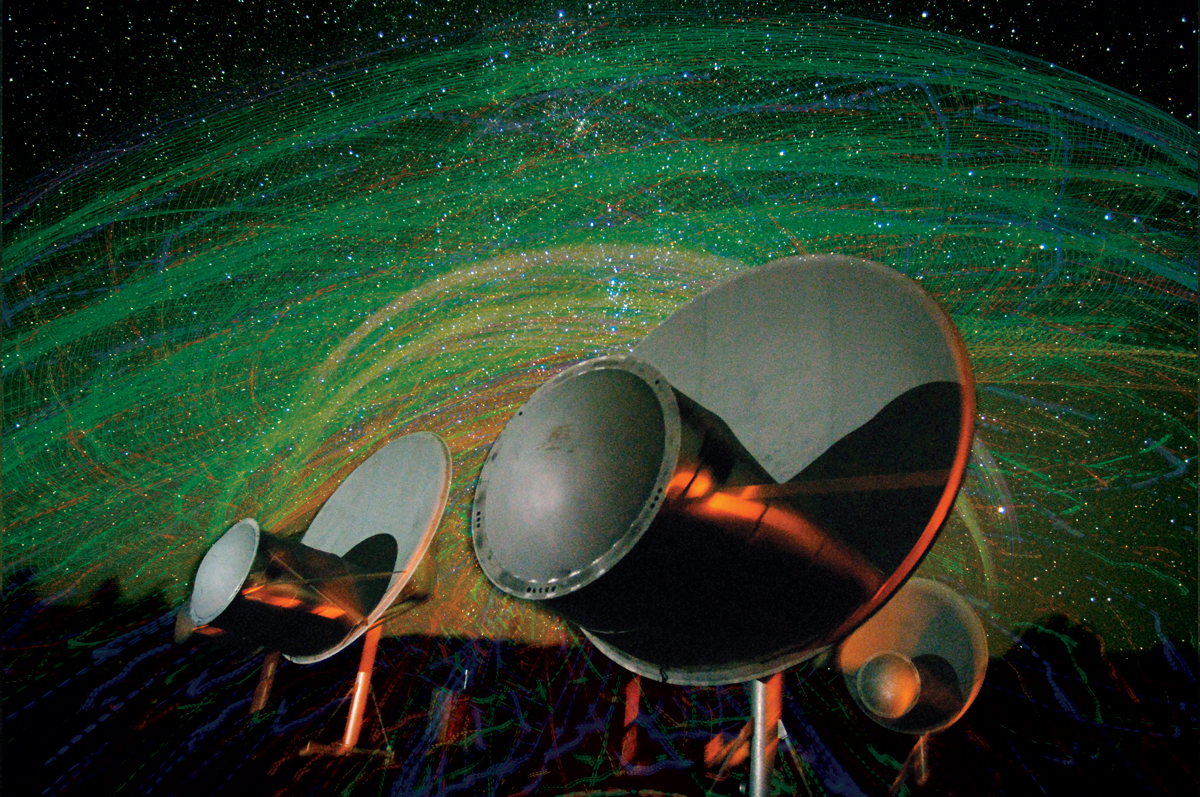
Jun 3, 2026
SETI Institute Looks for Signs of Technology in Interstellar Visitor 3I/ATLAS
Observations with the Allen Telescope Array set new limits on possible signals from extraterrestrial transmitters. #Press Releases #ATA #3I/ATLAS #Hat Creek Radio Observatory #Radio Astronomy #SETI
Jun 1, 2026
SETI Institute Awards $1 Million in STRIDE Grants to Advance Astrobiology, Exoplanet Science, and Public Engagement
#Press Releases #STRIDE #Research #Carl Sagan Center #Spectroscopy #Solar System #SETI #Climate and Bioscience #Astronomy #Astrobiology #Exoplanets #Data Science #Education #Outreach #Hat Creek Radio Observatory #Unistellar #SkyMapper
Jun 9, 2026
#SkyMapper
#Franck Marchis
#SETI
#citizen science
Jun 8, 2026
#Blog
#Drake Awards
#Lori Marino
#SETI
The Sounds of Intelligence: A Conversation with 2026 Drake Award Recipient Lori Marino
Jun 5, 2026
#Press Releases
#SETI
#Astronomy
#Bill Diamond
#SETI Institute
Beyond Disclosure Day: The Real-World Protocols
Jun 4, 2026
#SETI Institute in the News
#SETI Institute
#Community
#Solar System
#Matija Ćuk
#Neptune
#SETI
#Bill Diamond
#UAPs
#Drake Awards
#Lori Marino
#Matthew Tiscareno
#Outreach
#Exoplanets
#Carl Sagan Center
SETI Institute In the News: May Roundup 2026
Jun 3, 2026
SETI Institute Looks for Signs of Technology in Interstellar Visitor 3I/ATLAS
Observations with the Allen Telescope Array set new limits on possible signals from extraterrestrial transmitters.
#Press Releases
#ATA
#3I/ATLAS
#Hat Creek Radio Observatory
#Radio Astronomy
#SETI
Jun 1, 2026
#Press Releases
#STRIDE
#Research
#Carl Sagan Center
#Spectroscopy
#Solar System
#SETI
#Climate and Bioscience
#Astronomy
#Astrobiology
#Exoplanets
#Data Science
#Education
#Outreach
#Hat Creek Radio Observatory
#Unistellar
#SkyMapper
SETI Institute Awards $1 Million in STRIDE Grants to Advance Astrobiology, Exoplanet Science, and Public Engagement
Research
Related Projects

SkyMapper • SETI • Citizen Science • Astronomy
SkyMapper: Expanding Access to Real-time Astronomy Through a Global Astronomical Network
SkyMapper and the SETI Institute are connecting educators, students and the public to live astronomical observations through a distributed astronomical network. #SkyMapper #SETI #Citizen Science #Astronomy
VPL
Virtual Planetary Laboratory
How can we best assess whether an exoplanet supports life? #VPL
Discovery and Futures Lab
Discovery and Futures Lab
What happens if life beyond Earth is discovered? The Discovery and Futures Lab at the SETI Institute fosters novel and anticipatory research at the intersection of science, society, our planet, and the search for life beyond Earth. #Discovery and Futures Lab
May 17, 2026
SkyMapper: Expanding Access to Real-time Astronomy Through a Global Astronomical Network
SkyMapper and the SETI Institute are connecting educators, students and the public to live astronomical observations through a distributed astronomical network.
#SkyMapper
#SETI
#Citizen Science
#Astronomy
May 5, 2026
Virtual Planetary Laboratory
How can we best assess whether an exoplanet supports life?
#VPL
Apr 16, 2026
Discovery and Futures Lab
What happens if life beyond Earth is discovered? The Discovery and Futures Lab at the SETI Institute fosters novel and anticipatory research at the intersection of science, society, our planet, and the search for life beyond Earth.
#Discovery and Futures Lab
Support Us
Support the
SETI Institute
Scientists are getting closer in their search for life beyond earth. But with limited federal funding for the search for extraterrestrial intelligence, supporters are the reason cutting-edge scientists can keep their eyes on the sky.
