)

Wednesday, Nov 05, 2025

Image Credit: Danielle Futselaar / Breakthrough Listen.
At a Glance:
|
Listen to this article read by AI:
In a significant advance for astronomy, researchers from the Breakthrough Listen initiative, working in collaboration with NVIDIA and utilizing their system on the SETI Institute's Allen Telescope Array (ATA) in California, have improved the process for detecting Fast Radio Bursts (FRBs). Their newly developed artificial intelligence system outperforms existing methods, operating hundreds of times faster than current pipelines while maintaining accuracy.
Detailed in the peer-reviewed journal Astronomy & Astrophysics, the new system operates on NVIDIA's Holoscan platform, designed to process massive streaming datasets in real-time. Traditionally, FRB detection requires "dedispersion” — searching through thousands of possible signal parameters to correct for frequency-dependent time delays. The new end-to-end AI architecture eliminates that bottleneck, analyzing signals in real time and transforming how astronomers search for transient and potentially artificial signals from space.
The performance gains are notable. At the ATA, the state-of-the-art pipeline currently takes approximately 59 seconds to process 16.3 seconds of observational data — nearly four times slower than real-time. The new AI-driven system performs the same task 600 times faster, operating over 160 times faster than real-time.
“This represents a paradigm shift in how we search for fast transient phenomena across the cosmos,” said Peter Ma, who led the paper while an undergraduate at the University of Toronto and is now a graduate student at UC Berkeley. “We’ve created a system that can outpace massive data streams while maintaining the sensitivity needed to detect the unexpected.”
The system also demonstrated 7% better accuracy. It reduced false positives by nearly a factor of ten compared to existing pipelines — an important improvement for large-scale surveys that must sift through millions of candidate signals. This precision enables rapid follow-up observations, essential both for identifying the sources of FRBs and for spotting technosignatures — potential indicators of intelligent life.
“This technology doesn’t just make us faster at finding known types of signals — it allows us to discover completely new signal morphologies,” said Dr. Andrew Siemion, Bernard M. Oliver Chair for SETI at the SETI Institute and Principal Investigator for Breakthrough Listen. “An advanced civilization might use burst-like or modulated transmissions that we haven’t even imagined. This AI system can learn to recognize patterns that humans might overlook entirely.”
In tests, the system successfully detected giant pulses from the Crab Pulsar, handling a staggering 86 gigabits per second data stream with ease. Its scalability means it could be deployed at telescopes worldwide, forming a global, real-time detection network for both natural and astrophysical phenomena, as well as potential extraterrestrial signals.
This achievement builds on years of work by scientists and engineers at Breakthrough Listen, as well as collaborations between Breakthrough Listen, the SETI Institute, and academic and industry partners, including NVIDIA, expanding the frontiers of what real-time AI can accomplish in astronomy and the search for life beyond Earth.
Read Breakthrough Listen's Press Release: https://breakthroughlisten.web.ox.ac.uk/bl-holoscan







News
Related News
Jun 9, 2026
Disclosure Needs Data
#SkyMapper #Franck Marchis #SETI #citizen science
Jun 8, 2026
The Sounds of Intelligence: A Conversation with 2026 Drake Award Recipient Lori Marino
#Blog #Drake Awards #Lori Marino #SETI
Jun 5, 2026
Beyond Disclosure Day: The Real-World Protocols
#Press Releases #SETI #Astronomy #Bill Diamond #SETI Institute
Jun 4, 2026
SETI Institute In the News: May Roundup 2026
#SETI Institute in the News #SETI Institute #Community #Solar System #Matija Ćuk #Neptune #SETI #Bill Diamond #UAPs #Drake Awards #Lori Marino #Matthew Tiscareno #Outreach #Exoplanets #Carl Sagan Center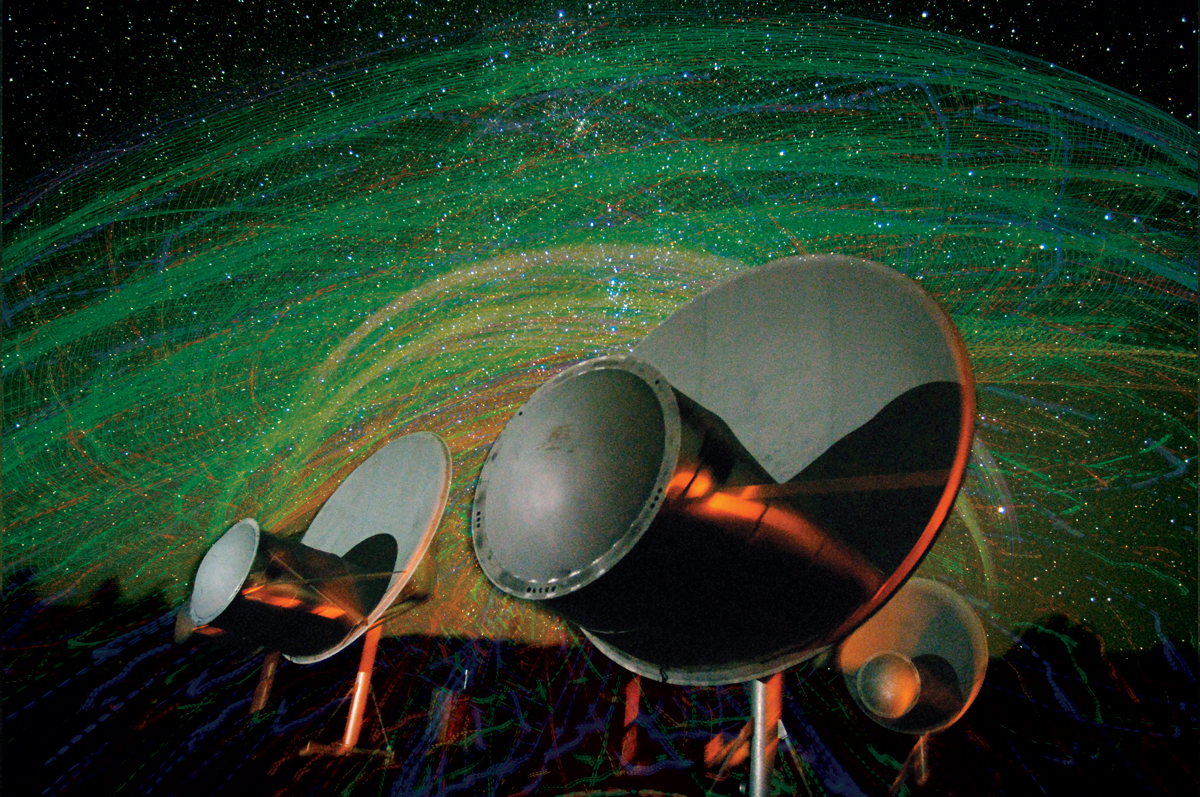
Jun 3, 2026
SETI Institute Looks for Signs of Technology in Interstellar Visitor 3I/ATLAS
Observations with the Allen Telescope Array set new limits on possible signals from extraterrestrial transmitters. #Press Releases #ATA #3I/ATLAS #Hat Creek Radio Observatory #Radio Astronomy #SETI
Jun 1, 2026
SETI Institute Awards $1 Million in STRIDE Grants to Advance Astrobiology, Exoplanet Science, and Public Engagement
#Press Releases #STRIDE #Research #Carl Sagan Center #Spectroscopy #Solar System #SETI #Climate and Bioscience #Astronomy #Astrobiology #Exoplanets #Data Science #Education #Outreach #Hat Creek Radio Observatory #Unistellar #SkyMapper
Jun 9, 2026
#SkyMapper
#Franck Marchis
#SETI
#citizen science
Jun 8, 2026
#Blog
#Drake Awards
#Lori Marino
#SETI
The Sounds of Intelligence: A Conversation with 2026 Drake Award Recipient Lori Marino
Jun 5, 2026
#Press Releases
#SETI
#Astronomy
#Bill Diamond
#SETI Institute
Beyond Disclosure Day: The Real-World Protocols
Jun 4, 2026
#SETI Institute in the News
#SETI Institute
#Community
#Solar System
#Matija Ćuk
#Neptune
#SETI
#Bill Diamond
#UAPs
#Drake Awards
#Lori Marino
#Matthew Tiscareno
#Outreach
#Exoplanets
#Carl Sagan Center
SETI Institute In the News: May Roundup 2026
Jun 3, 2026
SETI Institute Looks for Signs of Technology in Interstellar Visitor 3I/ATLAS
Observations with the Allen Telescope Array set new limits on possible signals from extraterrestrial transmitters.
#Press Releases
#ATA
#3I/ATLAS
#Hat Creek Radio Observatory
#Radio Astronomy
#SETI
Jun 1, 2026
#Press Releases
#STRIDE
#Research
#Carl Sagan Center
#Spectroscopy
#Solar System
#SETI
#Climate and Bioscience
#Astronomy
#Astrobiology
#Exoplanets
#Data Science
#Education
#Outreach
#Hat Creek Radio Observatory
#Unistellar
#SkyMapper
SETI Institute Awards $1 Million in STRIDE Grants to Advance Astrobiology, Exoplanet Science, and Public Engagement
Research
Related Projects

SkyMapper • SETI • Citizen Science • Astronomy
SkyMapper: Expanding Access to Real-time Astronomy Through a Global Astronomical Network
SkyMapper and the SETI Institute are connecting educators, students and the public to live astronomical observations through a distributed astronomical network. #SkyMapper #SETI #Citizen Science #Astronomy
VPL
Virtual Planetary Laboratory
How can we best assess whether an exoplanet supports life? #VPL
Discovery and Futures Lab
Discovery and Futures Lab
What happens if life beyond Earth is discovered? The Discovery and Futures Lab at the SETI Institute fosters novel and anticipatory research at the intersection of science, society, our planet, and the search for life beyond Earth. #Discovery and Futures Lab
May 17, 2026
SkyMapper: Expanding Access to Real-time Astronomy Through a Global Astronomical Network
SkyMapper and the SETI Institute are connecting educators, students and the public to live astronomical observations through a distributed astronomical network.
#SkyMapper
#SETI
#Citizen Science
#Astronomy
May 5, 2026
Virtual Planetary Laboratory
How can we best assess whether an exoplanet supports life?
#VPL
Apr 16, 2026
Discovery and Futures Lab
What happens if life beyond Earth is discovered? The Discovery and Futures Lab at the SETI Institute fosters novel and anticipatory research at the intersection of science, society, our planet, and the search for life beyond Earth.
#Discovery and Futures Lab
Support Us
Support the
SETI Institute
Scientists are getting closer in their search for life beyond earth. But with limited federal funding for the search for extraterrestrial intelligence, supporters are the reason cutting-edge scientists can keep their eyes on the sky.
