)

Monday, Aug 22, 2011
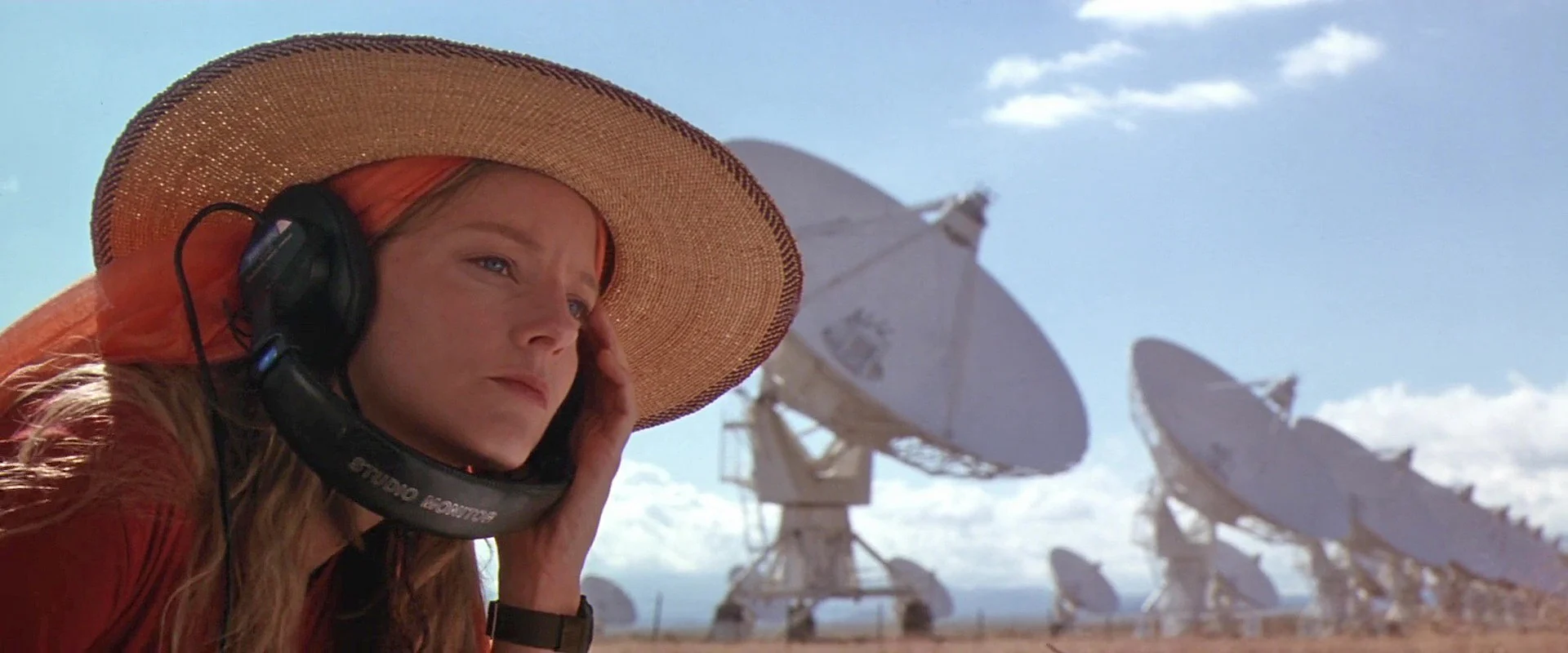
Ellie Arroway (Jodie Foster), the heroine of the movie "Contact," finds an alien broadcast in much the same way that Project Phoenix operated. Phoenix was searching for signals from the directions of about 1,000 nearby, sun-like stars. There were other SETI experiments underway, but Project Phoenix was the only systematic targeted search of individual stars, the type of search conducted in the movie. Project Phoenix ran from 1995 - 2004.
Much as in the movie, the senior scientist in the search is a female Ph.D. astronomer named Jill Tarter. However, Jodie Foster's character Ellie is not directly based on Jill. "Carl Sagan wrote a book about a woman who does what I do, not about me," explains Tarter. "He did his homework, and thus included many of the `character-building' experiences that are common to women scientists studying and working in a male-dominated profession, so Ellie seems very familiar to me."
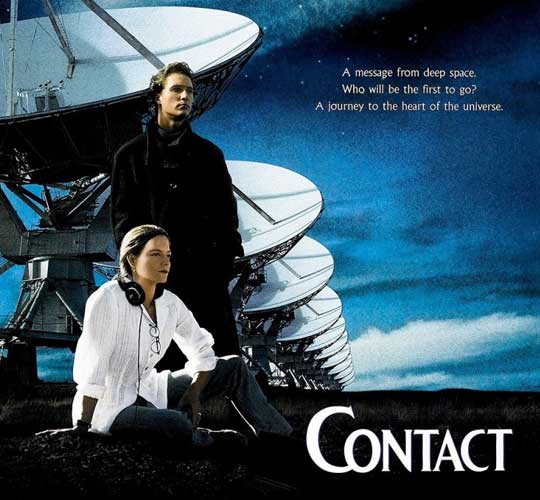
Another reality-inspired character in the movie is the blind researcher, Kent Clark. Dr. Clark was formerly Director of Research and Development for Project Phoenix, and the leader of its signal detection team is a blind Ph.D. physicist named Kent Cullers. According to Cullers, "An early version of the screenplay included a small part for which I was judged competent enough to play myself. However, as the part expanded, it required the skills of a real actor."
| Movie Version | Reality Check |
| Detection of a radio signal from an extraterrestrial technological civilization is made at the Very Large Array (VLA), in New Mexico, after Ellie's experiment in Arecibo, Puerto Rico, is shut down by myopic bureaucrats. | Despite having 27 antennas, the VLA is four times smaller in collecting area than Arecibo. It is therefore less sensitive, and less suitable for SETI. In addition, use of the VLA would require 27 copies of our receiving system, a formidably expensive proposition! Of course, there's no denying that the VLA is very photogenic. |
| When her SETI project is shut down, Ellie turns to a Howard Hughes-like private donor to continue the search. | When Senator Richard Bryan of Nevada amended the NASA appropriation bill of 1994 to kill SETI, the SETI Institute had to seek private funding. Today the SETI Institute is actively involved in trying to establish a $100 million endowment to ensure that the searching can continue as long as necessary. |
| Ellie detects aliens on the airwaves while listening with earphones. | Project Phoenix examines 28 million channels simultaneously. Instead, computers scan for signals, and only alert the astronomers when interesting ones appear. |
| When Ellie stylishly suits up for the White House press conference (only to be upstaged by Drumlin), she is wearing an attractive blue and white pin with a telescope logo. | In fact, Ellie is wearing one of our SETI Institute pins. Those of you with really good eyesight may have seen the NASA HRMS pin in the lapel of Fish's suit during the Arecibo party scene. Thanks to Senator Bryan, those are no longer available. |
Despite such minor quibbles, there's no doubt that "Contact" is indescribably more accurate in its depiction of SETI than any Hollywood film in history.







News
Related News
Jul 10, 2026
SETI Institute Achievements: Q1 2026 Activity Report
#Activity Reports #Carl Sagan Center #Outreach #Education #AIR #Community #Research
Jun 4, 2026
SETI Institute In the News: May Roundup 2026
#SETI Institute in the News #SETI Institute #Community #Solar System #Matija Ćuk #Neptune #SETI #Bill Diamond #UAPs #Drake Awards #Lori Marino #Matthew Tiscareno #Outreach #Exoplanets #Carl Sagan Center
Jun 1, 2026
SETI Institute Awards $1 Million in STRIDE Grants to Advance Astrobiology, Exoplanet Science, and Public Engagement
#Press Releases #STRIDE #Research #Carl Sagan Center #Spectroscopy #Solar System #SETI #Climate and Bioscience #Astronomy #Astrobiology #Exoplanets #Data Science #Education #Outreach #Hat Creek Radio Observatory #Unistellar #SkyMapper
May 5, 2026
Atlanta Science Festival Exploration Expo and the Arecibo Message
#Community #SETI Institute #Outreach #Education #Lauren Sgro
May 1, 2026
Asteroid Named in Honor of SETI Researcher and Communicator Seth Shostak
#Comets, Meteors, and Asteroids #Seth Shostak #SETI #Astronomy #Big Picture Science #Outreach #Andrew Fraknoi
Apr 15, 2026
2025 SETI Institute Activity Report
#Activity Reports #Carl Sagan Center #Outreach #Education #AIR #Community
Jul 10, 2026
#Activity Reports
#Carl Sagan Center
#Outreach
#Education
#AIR
#Community
#Research
Jun 4, 2026
#SETI Institute in the News
#SETI Institute
#Community
#Solar System
#Matija Ćuk
#Neptune
#SETI
#Bill Diamond
#UAPs
#Drake Awards
#Lori Marino
#Matthew Tiscareno
#Outreach
#Exoplanets
#Carl Sagan Center
SETI Institute In the News: May Roundup 2026
Jun 1, 2026
#Press Releases
#STRIDE
#Research
#Carl Sagan Center
#Spectroscopy
#Solar System
#SETI
#Climate and Bioscience
#Astronomy
#Astrobiology
#Exoplanets
#Data Science
#Education
#Outreach
#Hat Creek Radio Observatory
#Unistellar
#SkyMapper
SETI Institute Awards $1 Million in STRIDE Grants to Advance Astrobiology, Exoplanet Science, and Public Engagement
May 5, 2026
#Community
#SETI Institute
#Outreach
#Education
#Lauren Sgro
Atlanta Science Festival Exploration Expo and the Arecibo Message
May 1, 2026
#Comets, Meteors, and Asteroids
#Seth Shostak
#SETI
#Astronomy
#Big Picture Science
#Outreach
#Andrew Fraknoi
Asteroid Named in Honor of SETI Researcher and Communicator Seth Shostak
Apr 15, 2026
#Activity Reports
#Carl Sagan Center
#Outreach
#Education
#AIR
#Community
2025 SETI Institute Activity Report
Research
Related Projects

SkyMapper • SETI • Citizen Science • Astronomy
SkyMapper: Expanding Access to Real-time Astronomy Through a Global Astronomical Network
SkyMapper and the SETI Institute are connecting educators, students and the public to live astronomical observations through a distributed astronomical network. #SkyMapper #SETI #Citizen Science #Astronomy
VPL
Virtual Planetary Laboratory
How can we best assess whether an exoplanet supports life? #VPL
Discovery and Futures Lab
Discovery and Futures Lab
What happens if life beyond Earth is discovered? The Discovery and Futures Lab at the SETI Institute fosters novel and anticipatory research at the intersection of science, society, our planet, and the search for life beyond Earth. #Discovery and Futures Lab
May 17, 2026
SkyMapper: Expanding Access to Real-time Astronomy Through a Global Astronomical Network
SkyMapper and the SETI Institute are connecting educators, students and the public to live astronomical observations through a distributed astronomical network.
#SkyMapper
#SETI
#Citizen Science
#Astronomy
May 5, 2026
Virtual Planetary Laboratory
How can we best assess whether an exoplanet supports life?
#VPL
Apr 16, 2026
Discovery and Futures Lab
What happens if life beyond Earth is discovered? The Discovery and Futures Lab at the SETI Institute fosters novel and anticipatory research at the intersection of science, society, our planet, and the search for life beyond Earth.
#Discovery and Futures Lab
Support Us
Support the
SETI Institute
Scientists are getting closer in their search for life beyond earth. But with limited federal funding for the search for extraterrestrial intelligence, supporters are the reason cutting-edge scientists can keep their eyes on the sky.
