)

Author: Bonnie Chi
Monday, Mar 03, 2025

Screenshot of GIF: Shape Model 1999AP10. Credit: Josef Hanuš, Charles University.
Countless asteroids in our solar system, some close, some far — but did you know that some of these space rocks have names? Several years ago, Unistellar held a contest to name an asteroid its citizen astronomers had observed. Now, an asteroid (albeit a different one) finally bears the name the public chose.
On October 19th, 2020, a near-Earth asteroid named 159402 (1999AP10) was making its close approach to the Earth. This proximity gave professional and citizen astronomers around the world a remarkable opportunity to observe this object. Taking advantage of this chance, astronomers at the SETI Institute enlisted the SETI/Unistellar Network of citizen scientists to gather timely data. Researchers needed such data to reverse engineer the detailed shape of this space rock, allowing them to accurately map this asteroid.
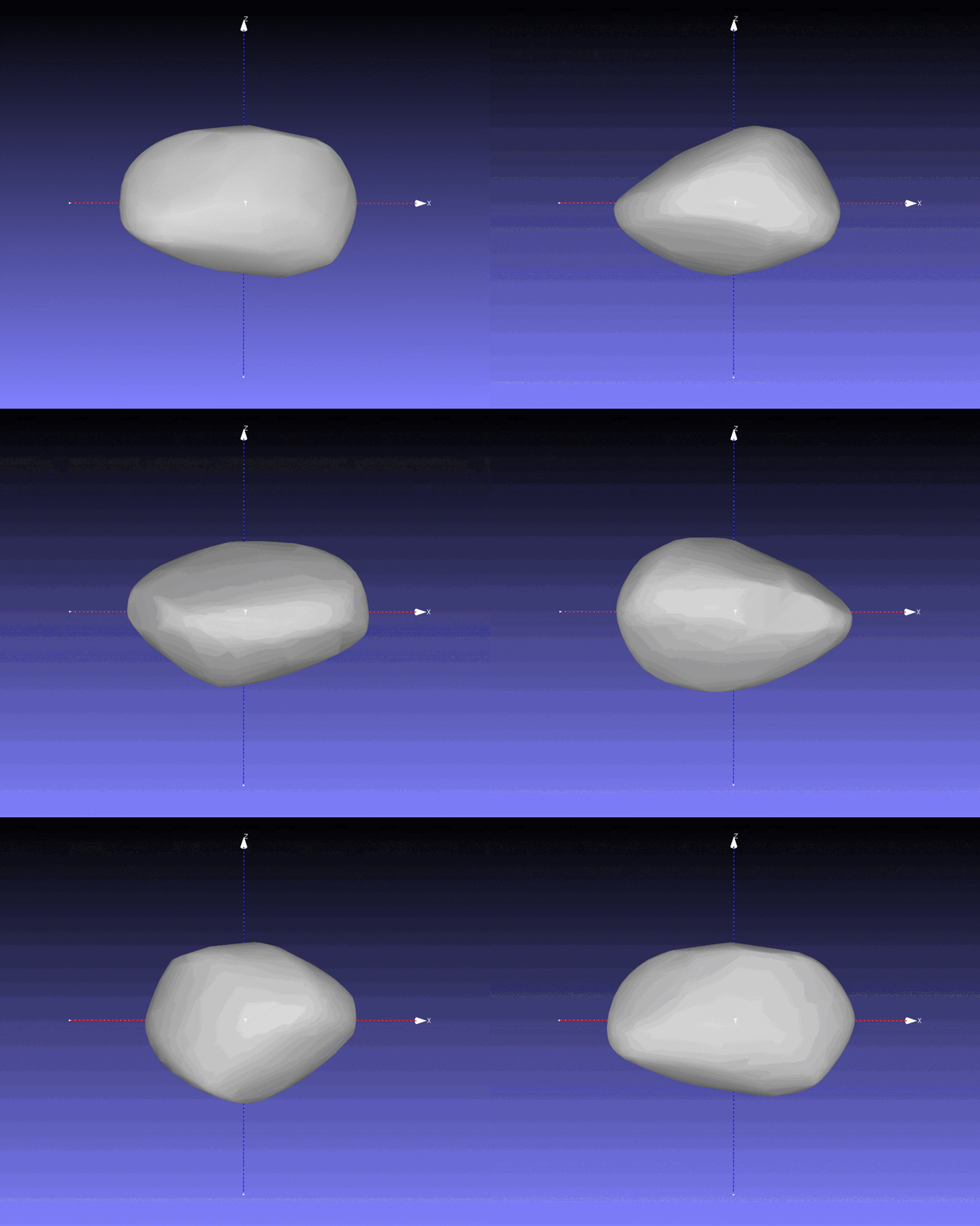
1999AP10 proved to have the shape of a flattened, lumpy potato while boasting the size of Mount Everest. Although 1999AP10 was the 69th asteroid with a known shape model, this is the first time citizen astronomers made the discovery possible. In celebration of this world first, Unistellar launched a contest where astronomy enthusiasts worldwide could propose and vote on a name for the asteroid. “We worked with the SETI Institute and several astronomy-focused institutions around the world to build and promote a platform so anybody with a bit of creativity and interest in astronomy could submit a name. We received more than 100 different suggestions,” mentioned Dr. Franck Marchis, astronomer and Director of Citizen Science at the SETI Institute, who was a judge on Unistellar’s naming panel. Among the submissions were funny, light-hearted ideas such as “RockyMcRockFace” and “Blind Melon,” but the overwhelming winner was “Ada Carrera,” and quite fittingly so.
Ada Amelia Carrera Rodríguez (1936-2020) was a passionate astronomer and inspiration for women who were as enthusiastic about studying space as she. As a pioneer of spreading astronomical awareness in Mexico, “she was passionate about sharing astronomy with people from all walks of life,” says Lourdes Cahuich, a friend of Carrera’s and amateur astronomer.
To forward her mission of accessible astronomy for everyone, Carrera founded the group Astronomía Educativa (Educational Astronomy) in 1994. This society empowered local amateur astronomers to teach, observe, and conduct outreach within their communities. Alongside her son and fellow observers, she traveled Mexico and South America to visit schools weekly, host numerous star parties, and hunt for celestial events to share with others. Ada Carrera was a powerhouse in the Latin astronomy community, and astronomers have now honored her with a celestial object, ensuring she is remembered.

Ada Amelia Carrera Rodríguez, amateur astronomer and motorcyclist. Source.
Despite her glowing legacy and the petition to have 1999AP10 renamed “159402 AdaCarrera,” this new name unfortunately did not fit the naming standards set by the International Astronomical Union (IAU). According to the IAU, near-Earth asteroids must bear mythological names. As a result, the IAU decided to name a different asteroid after Carrera and her memory.
Nearly five times larger than our near-Earth neighbor 1999AP10 and almost the size of the San Francisco Bay, asteroid 20008 (1991NC3) was officially named after Ada Carrera in 2023. Now known as 20008 Adacarrera, this rocky body does not approach Earth and, therefore, satisfies the IAU’s naming criteria. Instead, 20008 Adacarrera is a “main-belt” asteroid that floats comfortably in the asteroid belt, always staying between the orbits of Mars and Jupiter. Amongst millions of other floating space rocks that call this belt home, 20008 Adacarrera is one of the largest with a diameter greater than 99% of known asteroids.
One specific space rock may seem small in the context of our Solar System, but amongst their kind, 20008 Adacarrera is monumental — just as Carrera was during her time here. “She was a wonderful person with a wonderful life,” Cahuich fondly recalls, and now her memory will orbit on. This tale may have two asteroids, but one brilliant woman’s legacy is now in the cosmos.







News
Related News

Jun 1, 2026
SETI Institute Awards $1 Million in STRIDE Grants to Advance Astrobiology, Exoplanet Science, and Public Engagement
#Press Releases #STRIDE #Research #Carl Sagan Center #Spectroscopy #Solar System #SETI #Climate and Bioscience #Astronomy #Astrobiology #Exoplanets #Data Science #Education #Outreach #Hat Creek Radio Observatory #Unistellar #SkyMapper
May 1, 2026
Asteroid Named in Honor of SETI Researcher and Communicator Seth Shostak
#Comets, Meteors, and Asteroids #Seth Shostak #SETI #Astronomy #Big Picture Science #Outreach #Andrew Fraknoi
Apr 30, 2026
Narrowing the Search: The 45 Best Targets for Alien Life
#Blog #Astronomy #JWST #NASA Missions and Observatories #Trappist-1 #LaserSETI #ATA #Franck Marchis
Apr 23, 2026
SkyMapper Goes Live: Building a Real-Time, Global Network for Astronomy
SkyMapper functions as an observational infrastructure, a system that links instruments, users, and data streams. Its goal is ambitious: to continuously observe and map the entire sky. #Blog #SkyMapper #LaserSETI #SETI #Astronomy #Exoplanet Detection #Comets, Meteors, and Asteroids #Planetary Defense #Technosignatures #Franck Marchis #Lauren Sgro
Apr 3, 2026
SETI Institute In the News: March Roundup 2026
In March 2026, SETI Institute researchers contributed to a wide range of conversations about our solar system and the search for life beyond Earth. From explaining unusual features on Mars and studying meteor airbursts in Earth’s atmosphere to advancing new ways of detecting technosignatures, this work reflects how scientists are continually refining our understanding of both nearby and distant worlds. #SETI Institute in the News #SETI Institute #Community #Mars #Pascal Lee #Peter Jenniskens #Comets, Meteors, and Asteroids #Astronomy #Vishal Gajjar #SETI #AI and Machine Learning #Astrobiology #Nathalie Cabrol #Carl Sagan Center #Seth Shostak #Movie Reviews #Bill Diamond
Mar 31, 2026
The Science of SETI: Inside the First Modern Textbook
#Blog #SETI #Technosignatures #Astronomy #Jason Wright #SETI Institute
Jun 1, 2026
#Press Releases
#STRIDE
#Research
#Carl Sagan Center
#Spectroscopy
#Solar System
#SETI
#Climate and Bioscience
#Astronomy
#Astrobiology
#Exoplanets
#Data Science
#Education
#Outreach
#Hat Creek Radio Observatory
#Unistellar
#SkyMapper
May 1, 2026
#Comets, Meteors, and Asteroids
#Seth Shostak
#SETI
#Astronomy
#Big Picture Science
#Outreach
#Andrew Fraknoi
Asteroid Named in Honor of SETI Researcher and Communicator Seth Shostak
Apr 30, 2026
#Blog
#Astronomy
#JWST
#NASA Missions and Observatories
#Trappist-1
#LaserSETI
#ATA
#Franck Marchis
Narrowing the Search: The 45 Best Targets for Alien Life
Apr 23, 2026
SkyMapper Goes Live: Building a Real-Time, Global Network for Astronomy
SkyMapper functions as an observational infrastructure, a system that links instruments, users, and data streams. Its goal is ambitious: to continuously observe and map the entire sky.
#Blog
#SkyMapper
#LaserSETI
#SETI
#Astronomy
#Exoplanet Detection
#Comets, Meteors, and Asteroids
#Planetary Defense
#Technosignatures
#Franck Marchis
#Lauren Sgro
Apr 3, 2026
SETI Institute In the News: March Roundup 2026
In March 2026, SETI Institute researchers contributed to a wide range of conversations about our solar system and the search for life beyond Earth. From explaining unusual features on Mars and studying meteor airbursts in Earth’s atmosphere to advancing new ways of detecting technosignatures, this work reflects how scientists are continually refining our understanding of both nearby and distant worlds.
#SETI Institute in the News
#SETI Institute
#Community
#Mars
#Pascal Lee
#Peter Jenniskens
#Comets, Meteors, and Asteroids
#Astronomy
#Vishal Gajjar
#SETI
#AI and Machine Learning
#Astrobiology
#Nathalie Cabrol
#Carl Sagan Center
#Seth Shostak
#Movie Reviews
#Bill Diamond
Mar 31, 2026
#Blog
#SETI
#Technosignatures
#Astronomy
#Jason Wright
#SETI Institute
The Science of SETI: Inside the First Modern Textbook
Research
Related Projects

SkyMapper • SETI • Citizen Science • Astronomy
SkyMapper: Expanding Access to Real-time Astronomy Through a Global Astronomical Network
SkyMapper and the SETI Institute are connecting educators, students and the public to live astronomical observations through a distributed astronomical network. #SkyMapper #SETI #Citizen Science #Astronomy
VPL
Virtual Planetary Laboratory
How can we best assess whether an exoplanet supports life? #VPL
Discovery and Futures Lab
Discovery and Futures Lab
What happens if life beyond Earth is discovered? The Discovery and Futures Lab at the SETI Institute fosters novel and anticipatory research at the intersection of science, society, our planet, and the search for life beyond Earth. #Discovery and Futures Lab
May 17, 2026
SkyMapper: Expanding Access to Real-time Astronomy Through a Global Astronomical Network
SkyMapper and the SETI Institute are connecting educators, students and the public to live astronomical observations through a distributed astronomical network.
#SkyMapper
#SETI
#Citizen Science
#Astronomy
May 5, 2026
Virtual Planetary Laboratory
How can we best assess whether an exoplanet supports life?
#VPL
Apr 16, 2026
Discovery and Futures Lab
What happens if life beyond Earth is discovered? The Discovery and Futures Lab at the SETI Institute fosters novel and anticipatory research at the intersection of science, society, our planet, and the search for life beyond Earth.
#Discovery and Futures Lab
Support Us
Support the
SETI Institute
Scientists are getting closer in their search for life beyond earth. But with limited federal funding for the search for extraterrestrial intelligence, supporters are the reason cutting-edge scientists can keep their eyes on the sky.
