)

Author: Seth Shostak
Thursday, Aug 17, 2017
Here’s a question I’ve been asked two hundred times in the past half-hour: What equipment do I need to ensure my enjoyment of Monday’s solar eclipse? Even if I’m not in the path of totality?
The answer is simple. You require your eyes, a tube of sunscreen to avoid frying your epidermis, eclipse glasses or filters, … and binoculars.
That’s right: binoculars. Sure, you could borrow Uncle Sydney’s 5-inch refractor with the double-cam tracking motor and prize-winning achromatic optics. But who would want to truck that hardware to their viewing site? In addition, Sydney’s ponderous ‘scope would merely tempt you to waste two minutes of totality fiddling with sighting and focus.
Bummer, for sure.
Binoculars, on the other hand, can be transported by dog, require no setup, and will be useful both inside and outside the path of totality. Even better, you can try them out before the eclipse begins (heck, you can try them out today!)
Now, if you’re among the fortunate folk who will be in the 60-mile swath of totality, binoculars will give you a substantially better view once the Sun blinks out. You can see details of the inner corona and bright red prominences sticking up from the Sun’s limb like luminescent whiskers. It’s really a much better view than just using your eyes.
But what about the two hours of eclipse before and after totality? Or what if you’re in the 95 percent of the lower 48 that is outside that favored path?
You can still put those binoculars to good use. But, of course, you need eye protection.
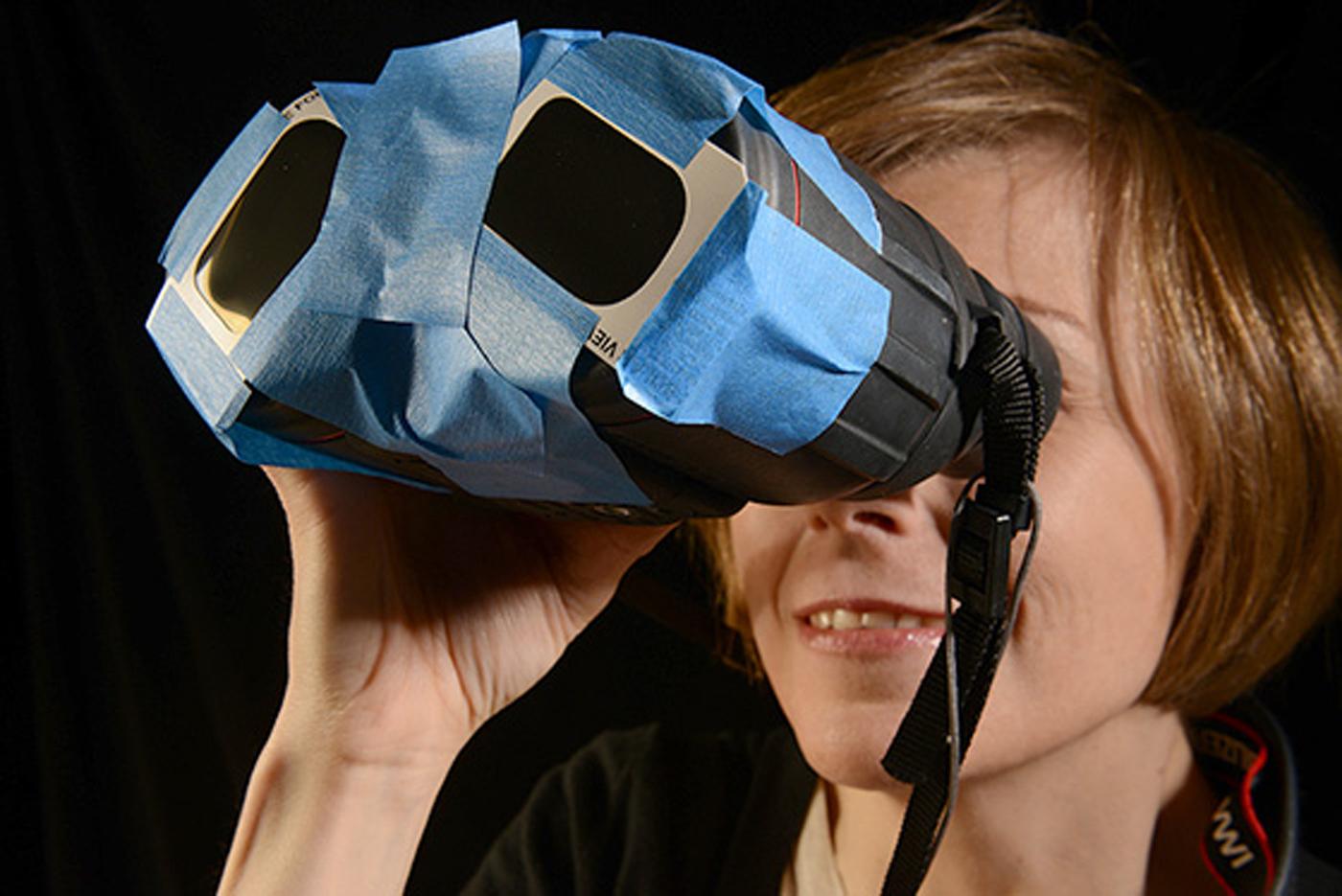
Cut up a pair of (ISO certified) eclipse glasses, and attach them to your binoculars with masking tape (on the lenses AWAY from your eyes. See photo.) Be sure to use enough sticky stuff to completely block the objective lenses, other than where the filters or cardboard are. And, as even the meanest intelligence should understand, don’t use transparent tape.
When you look through this assembly, the world will appear completely dark. Check it out by aiming at the blue sky, just to make sure there are no light leaks. If you’re not careful about this, you could end up boiling your retinas, which means this eclipse would be your last.
Now you’ll have two hours to use this hi-tech setup to enjoy a better view of the moon taking a bite out of the Sun. You should be able to see sunspots too, although when I looked recently the Sun’s surface was as unblemished as Mother Theresa’s reputation. There were two tiny sunspots. You may see more.
The difficult part of all this, believe it or not, is wrangling the binoculars in the Sun’s direction. This requires a bit of hand-eye coordination, but you have two hours to get it right. A good idea is to practice in advance by looking at the Sun before the eclipse. If you don’t succeed at seeing Sol, give up on those plans to pursue a career in neurosurgery or as an Army sniper.
Two things to keep in mind:
- Make sure the tape and glasses are light-proof. The binoculars can damage your baby blues faster than a greased weasel. Also be careful about letting children do this … they might loosen the tape in a fit of prepubescent pique.
- If you’re in the path of totality, be sure to rip off the tape and glasses to observe that celestial spectacle without filtration. Missing this would be a shame, and put you at a severe disadvantage in party conversation after the eclipse.
Oh, and don’t forget to bring some treats for the dog.







News
Related News
Jul 10, 2026
SETI Institute Achievements: Q1 2026 Activity Report
#Activity Reports #Carl Sagan Center #Outreach #Education #AIR #Community #Research
Jun 4, 2026
SETI Institute In the News: May Roundup 2026
#SETI Institute in the News #SETI Institute #Community #Solar System #Matija Ćuk #Neptune #SETI #Bill Diamond #UAPs #Drake Awards #Lori Marino #Matthew Tiscareno #Outreach #Exoplanets #Carl Sagan Center
Jun 1, 2026
SETI Institute Awards $1 Million in STRIDE Grants to Advance Astrobiology, Exoplanet Science, and Public Engagement
#Press Releases #STRIDE #Research #Carl Sagan Center #Spectroscopy #Solar System #SETI #Climate and Bioscience #Astronomy #Astrobiology #Exoplanets #Data Science #Education #Outreach #Hat Creek Radio Observatory #Unistellar #SkyMapper
May 5, 2026
Atlanta Science Festival Exploration Expo and the Arecibo Message
#Community #SETI Institute #Outreach #Education #Lauren Sgro
May 1, 2026
Asteroid Named in Honor of SETI Researcher and Communicator Seth Shostak
#Comets, Meteors, and Asteroids #Seth Shostak #SETI #Astronomy #Big Picture Science #Outreach #Andrew Fraknoi
Apr 15, 2026
2025 SETI Institute Activity Report
#Activity Reports #Carl Sagan Center #Outreach #Education #AIR #Community
Jul 10, 2026
#Activity Reports
#Carl Sagan Center
#Outreach
#Education
#AIR
#Community
#Research
Jun 4, 2026
#SETI Institute in the News
#SETI Institute
#Community
#Solar System
#Matija Ćuk
#Neptune
#SETI
#Bill Diamond
#UAPs
#Drake Awards
#Lori Marino
#Matthew Tiscareno
#Outreach
#Exoplanets
#Carl Sagan Center
SETI Institute In the News: May Roundup 2026
Jun 1, 2026
#Press Releases
#STRIDE
#Research
#Carl Sagan Center
#Spectroscopy
#Solar System
#SETI
#Climate and Bioscience
#Astronomy
#Astrobiology
#Exoplanets
#Data Science
#Education
#Outreach
#Hat Creek Radio Observatory
#Unistellar
#SkyMapper
SETI Institute Awards $1 Million in STRIDE Grants to Advance Astrobiology, Exoplanet Science, and Public Engagement
May 5, 2026
#Community
#SETI Institute
#Outreach
#Education
#Lauren Sgro
Atlanta Science Festival Exploration Expo and the Arecibo Message
May 1, 2026
#Comets, Meteors, and Asteroids
#Seth Shostak
#SETI
#Astronomy
#Big Picture Science
#Outreach
#Andrew Fraknoi
Asteroid Named in Honor of SETI Researcher and Communicator Seth Shostak
Apr 15, 2026
#Activity Reports
#Carl Sagan Center
#Outreach
#Education
#AIR
#Community
2025 SETI Institute Activity Report
Research
Related Projects

SkyMapper • SETI • Citizen Science • Astronomy
SkyMapper: Expanding Access to Real-time Astronomy Through a Global Astronomical Network
SkyMapper and the SETI Institute are connecting educators, students and the public to live astronomical observations through a distributed astronomical network. #SkyMapper #SETI #Citizen Science #Astronomy
VPL
Virtual Planetary Laboratory
How can we best assess whether an exoplanet supports life? #VPL
Discovery and Futures Lab
Discovery and Futures Lab
What happens if life beyond Earth is discovered? The Discovery and Futures Lab at the SETI Institute fosters novel and anticipatory research at the intersection of science, society, our planet, and the search for life beyond Earth. #Discovery and Futures Lab
May 17, 2026
SkyMapper: Expanding Access to Real-time Astronomy Through a Global Astronomical Network
SkyMapper and the SETI Institute are connecting educators, students and the public to live astronomical observations through a distributed astronomical network.
#SkyMapper
#SETI
#Citizen Science
#Astronomy
May 5, 2026
Virtual Planetary Laboratory
How can we best assess whether an exoplanet supports life?
#VPL
Apr 16, 2026
Discovery and Futures Lab
What happens if life beyond Earth is discovered? The Discovery and Futures Lab at the SETI Institute fosters novel and anticipatory research at the intersection of science, society, our planet, and the search for life beyond Earth.
#Discovery and Futures Lab
Support Us
Support the
SETI Institute
Scientists are getting closer in their search for life beyond earth. But with limited federal funding for the search for extraterrestrial intelligence, supporters are the reason cutting-edge scientists can keep their eyes on the sky.
