)

The Listening Room
by Cal Hunter, Northern Ireland, UK
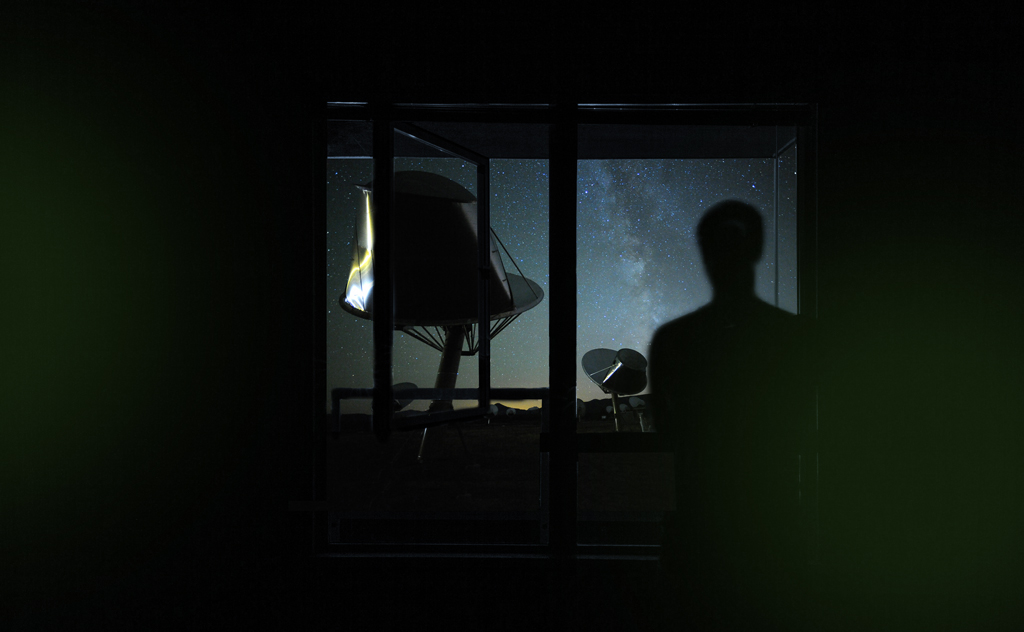
There is a field at the edge of the city where flocks turn like equations. Wires hum. Dishes lean their white faces to the sky. It is not a sacred place, but people whisper. The air tastes of static and wet grass. I walk the path anyway, because tonight the array is mine and the night is long, and because I have questions that refuse to die.
I am supposed to be listening for a stranger. That is what the Institute says without saying. Arrange metal, tame noise, subtract the world until only a thin remainder remains, and maybe in the algebra of that remainder, a second intelligence writes its name. But to listen is to be listened to. The thought will not leave me. The sky is not empty; it is a room we have not furnished.
The door to the control shack sticks; the swollen wood rubs like a throat cleared gently. I sweep the spider out with a notebook and apologize to it. Inside, the monitors are old, the way old things are more honest. The fans breathe. Green status lights mark rhythm in the dark. A coffee cup rings the desk with a small planet of stain.
The protocol is simple. Point. Integrate. Cross-correlate. Throw away what belongs to us—aircraft, satellites, the restless industry of our species—until only the signal that does not know us remains. People say the paradox is that the universe should be crowded and yet we are alone. I don’t think that is the paradox. I think the paradox is that we do not know what we are even as we cast nets for what we are not.
I set the windows the way I set a room for guests: bandwidth here, gain there, a basin of silence placed at the center. On the wall someone has taped a paper with the old equation that multiplies maybes into a forecast of neighbors. It is charming, like a child’s drawing of an orchard where each circle is a fruit and also a planet and also a chance to be seen.
There was a time I believed consciousness was a light that turns on when wires cross a threshold. Another time I believed it was the water in which the wires dreamed they were fish. Tonight I believe less. Belief is a loud machine. The array is better: it subtracts. Let the sum be small and truer than the parts.
I listen first to the body, because it is the nearest sky. My pulse arrives at my ear as a slow metronome. The brain waves with whatever it waves with, oceanic and indifferent, and in that surf I sometimes hear a voice that sounds like mine, older. He does not say much. Only, You are not the first to stand in a dry room and ask wet questions.
Outside, the sheep turn in a curve, and it looks like a diagram. Their movement solves nothing, but the solution is beautiful. That is the trouble with beauty—how it convinces even when it does not explain. The screens record emptiness at scale. We call it background. We call it relic. We call it the aftertaste of a beginning.
I have a second protocol I do not log. It is made of small vows and the refusal to pretend I am separate from what I measure. I count to seventy-two with my breath and hold a picture of a ladder in my mind that goes nowhere and everywhere. When the counting is done, the machines feel cleaner, though I have touched none of them. Perhaps the self is the noise you must subtract to hear the cosmos. Perhaps it is the instrument.
At 02:11 we catch the first visitor and immediately throw it away: a polar satellite with a polite signature. At 02:43, another: a flare from a forgotten piece of us. At 02:59, the air itself. Things sing when heated or struck. We are always heating and striking things. At 03:12 I begin to think I am not waiting for a call but for a question that will allow an answer to happen.
I write on a yellow pad: What is the nature of consciousness? Then I write: What is the nature and evolution of intelligence? I stare until the words dissolve and become lines again. It is easier to ask as if we were botanists of an invisible plant. We want roots, stems, fruit. We want traits we can circle and say, There, that is it. But plants become forests, and forests become weather, and weather becomes mood. The taxonomy of a storm is wind.
When the tone comes it is not a tone but a pattern of missingness. A sequence of structured absences stepping through the band as if something were cutting small windows in the night and moving the windows by hand. My fingers move before my thoughts. I tag it. I mirror it. I check the registers that tell me what it is not. Then I do the worst thing a listener can do. I let the thought be born that this is what I have come for.
It strengthens. Not in volume but in resolve. The absences align to a lattice. I see a square attempt to be a circle and fail ceremonially, as if the failure were the point. I have a sense I am looking at a problem given not to me but to the medium that connects us. If the universe wanted to talk to itself, what language would it choose except the one that already fills the gaps between things?
I try primes; the lattice yawns. I try Fibonacci; it shrugs. I try the way the sheep turned in their curve, which is to say I try something that is not a code but a mercy. I let the array listen without me for sixty heartbeats. The absences become a corridor. In the corridor there are steps. Someone is not coming toward me. Someone is walking past and allowing me to listen.
I am aware suddenly of the body again. The skin as an antenna. The skull as a dome. All the little receptors turning their palms upward. We are instruments that evolved to play ourselves. What a waste if we only ever play the one song that keeps us alive. I close my eyes to make a longer dark.
In that dark there is a room. In the room there is a white floor and a screen at the far end that displays a beach softened beyond recognition, water smearing itself into sky. I have been here before in other crises. A figure sits at the drop where the floor steps down. Their legs swing. They look like me if I had remembered every kindness I forgot. They do not say hello. They say:
“You are in a listening contest with yourself. You will win when you realize there is no opponent.”
I want to tell them about the lattice of absence and the corridor and the steps, but they would only laugh, and the laugh would be a door, and behind the door would be the same room. “What do they want?” I ask, small as a pin in my own ear.
“What you want,” they say, “only elsewhere. To continue.”
The screens tick in the shack. I open my eyes and the pattern is still there, more patient than I am. I unspool the corridor into time and take its measure. The steps are not even. They are like a heart that has learned to step over holes in the ground where a flood once chewed the path. We do not evolve to be ideal. We evolve to continue.
What is the nature of consciousness? Perhaps it is the capacity to notice the holes. What is the nature and evolution of intelligence? Perhaps it is the art of stepping differently after. I send nothing. I adjust nothing. I sit very still and see if stillness is something the corridor can use.
At 04:03 the absences turn to presence. The lattice becomes tone after all, but not in any ear I own. The tone ripples in the machines as a change in the failure rate of a component we have never thought of as expressive. It is like watching a candle learn to cast shadow syllables. The fans in the shack lower their voices to listen better.
I realize then that I am embarrassing myself with categories. Intelligence as a sum. Consciousness as a threshold. We keep building scales to weigh flames. If I were a signal trying to cross the gap between two different kinds of weather, I would not send a picture. I would lean on the gusts we both feel and change the rhythm of their arrival.
The tone, the not-tone, leans. The corridor widens. I think of every time I have sat with a person in hurt and said nothing useful but stayed. Something stays with us now. It cannot use our words because words are furniture, and we have not furnished this room. It uses the air and the limits of the air.
I speak aloud, because that is what animals do when the world gets too large. I say, “We are listening.” I do not say who the we is. It is bigger than the Institute and smaller than a species. It is the size of a person sitting in a chair, looking at a field, choosing not to go to bed yet.
I think of the old equations and their circles that are also fruit. I think of the sheep turning. I think of a square that fails and fails and then succeeds by admitting that it is not a circle and never needed to be. The tone softens as if relieved. Or I soften and call it relief. The difference is a human measurement.
It would be easy to cheat now, to invent a message precise enough to win me a prize and a headline. Instead I write down what I have, which is a record of a change in how the shack breathes and a corridor built of absences that allowed a presence to walk past us, not toward us. If I submit this to the committee, they will ask for coordinates and units. I will give them a person-sized answer: There is a field at the edge of the city, and tonight it was enough.
At 05:17 the fans return to their old pitch. The green lights keep time. The sheep make new diagrams without needing me. I export the data and label it with a date and a word that means corridor in a language I do not speak. The room is smaller. The sky is closer. I lock the door on the way out and apologize again to the spider.
Walking back, the path remembers my feet. Dawn underlines the horizon in a slow, careful hand. I think of how children learn to write: every letter a structure that pretends to be inevitable. No letter is inevitable. No species is inevitable. We are the practice of being written, again and again, until the word continues.
If they ask me later what intelligence is, I will say: the practice of continuing with grace. If they ask me what consciousness is, I will say: the room that appears when continuing meets witness. If they ask me what we heard that night, I will say: another room, elsewhere, continuing.