Planetary Picture of the Day - Week of September 9, 2024
Wednesday, Sep 18, 2024
Planetary Picture of the Day
Week of September 9, 2024
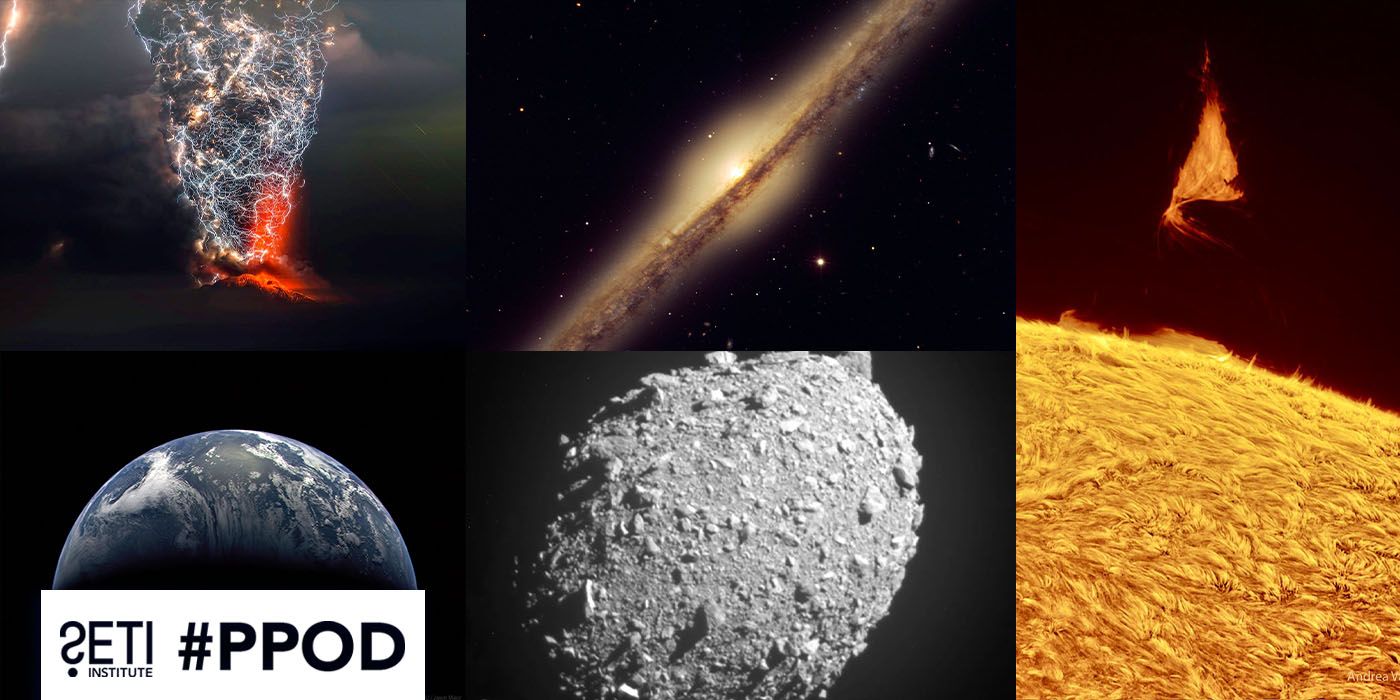
This week we focus on the astounding and beautiful, with photos of a galaxy, a solar prominence, volcanic lightning, an asteroid moonlet, and the Earth from a mission to Mercury.
Monday, 9 September 2024
Credit: ESO
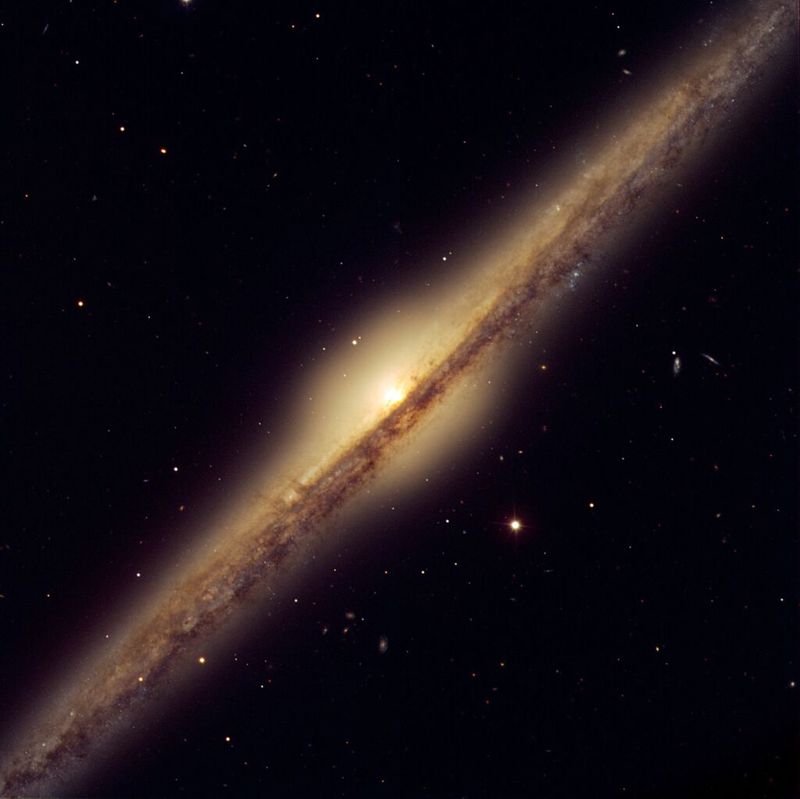
Midsummer's Dream Galaxy The galaxy pictured here is NGC 4565, which for obvious reasons is also called the Needle Galaxy, one of the most famous examples of an edge-on spiral galaxy and located some 30 million light-years away in the constellation Coma Berenices. It displays a bright yellowish central bulge that juts above the most impressive dust lanes.
Because it is relatively close (it is only 12 times farther away than Messier 31, the Andromeda galaxy, which is the major galaxy closest to us) and relatively large (roughly one-third larger than the Milky Way), it does not fit entirely into the field of view of the FORS instrument (about 7 x 7 arcmin2).
Many background galaxies are also visible in this FORS image, giving full meaning to their nickname of "island universes".
Tuesday, 10 September 2024
Credit: NASA/Johns Hopkins APL
Last Full Image of Dimophoros
Asteroid moonlet Dimorphos as seen by the DART spacecraft 11 seconds before impact. DART’s onboard DRACO imager captured this image from a distance of 42 miles (68 kilometers). This image was the last to contain all of Dimorphos in the field of view. Dimorphos is roughly 525 feet (160 meters) in length. This image is shown as it appears on the DRACO detector and is mirror-flipped across the x-axis from reality.
Wednesday, 11 September 2024
Credit: Andrea Vanoni https://buff.ly/4e3AWC3 Text: APOD
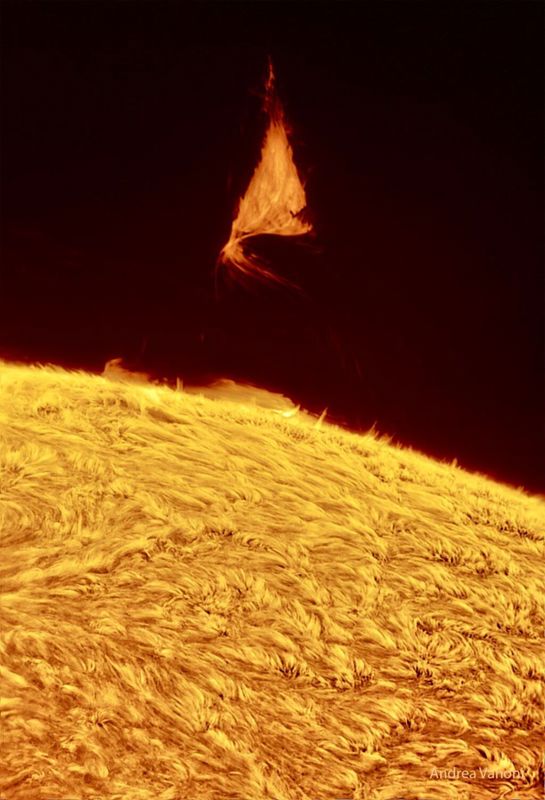
A Triangular Prominence Hovers Over the Sun
Why is there a triangle hovering over the Sun? Although the shape is unusual, the type of structure is not: it is part of an evolving solar prominence. Looping magnetic fields on the Sun channel the flow of energetic particles, sometimes holding glowing gaseous structures aloft for months. A prominence glows brightly because it contains particularly hot, dense, or opaque solar plasma. The surprising triangular structure occurred at the end of August. Larger than our Earth, the iconic prominence was imaged by several solar photographers and documented by NASA's Solar Dynamic Observatory to form and violently dissipate in about a day. The featured image was captured in a color of red light emitted strongly by hydrogen. Below, solar fibrils carpet the Sun's chromosphere, while the background sky is so faint in comparison that no stars are visible. Our Sun's surface has been quite active this year.
Thursday, 12 September 2024
Credit: Francisco Negroni
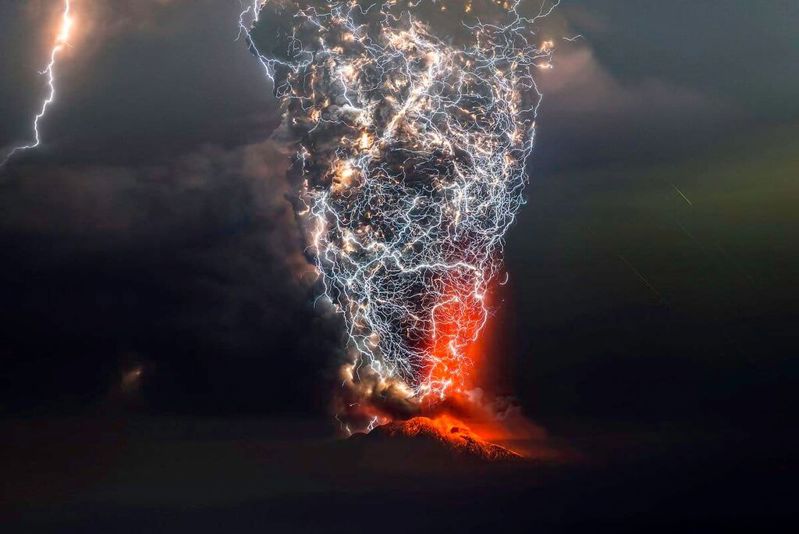
Volcanic Lightning
This stunning photograph captures the most violent moment during an eruption of the Calbuco volcano in Chile. Volcanic lightning occurs in the plumes of eruptions when volcanic ash particles collide, generating static electricity. Additionally, water vapor in the plume condenses and freezes as it rises, adding ice to the mix. And voila! The eventual electrical discharge causes lightning.
Friday, 13 September 2024
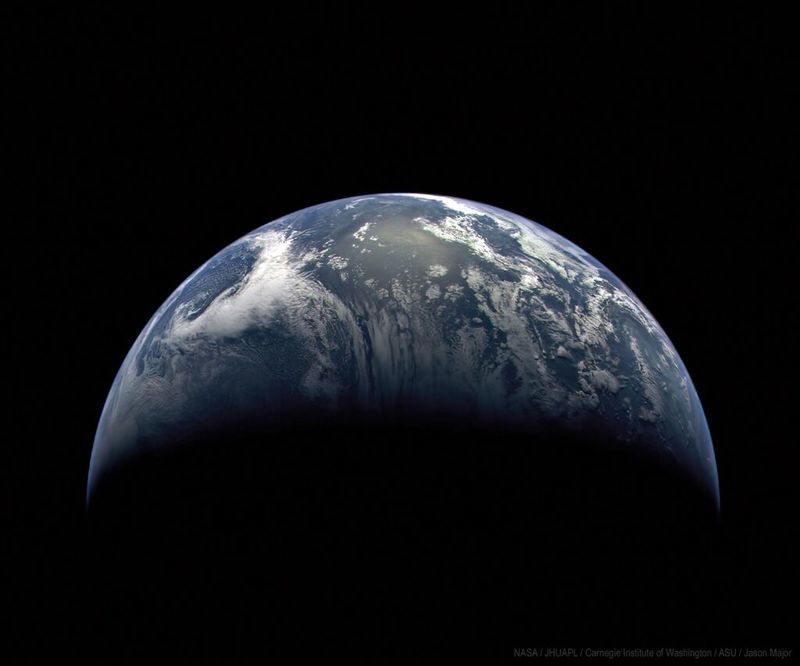
Credit: NASA/Johns Hopkins University Applied Physics Laboratory/Carnegie Institution of Washington/Jason Major
Earth via MESSENGER Sevice
A view of Earth made from image data acquired with the Mercury Dual Imaging System (MDIS) instrument on NASA's MESSENGER spacecraft on August 2, 2005, from a distance of about 67,000 km. Launched on August 3, 2004, the MESSENGER spacecraft's trajectory took it back to Earth for a gravity assist flyby a year later, enabling the capture of this view of our planet.
SkyMapper and the SETI Institute are connecting educators, students and the public to live astronomical observations through a distributed astronomical network.
#SkyMapper
#SETI
#Citizen Science
#Astronomy
What happens if life beyond Earth is discovered? The Discovery and Futures Lab at the SETI Institute fosters novel and anticipatory research at the intersection of science, society, our planet, and the search for life beyond Earth.
#Discovery and Futures Lab
SkyMapper and the SETI Institute are connecting educators, students and the public to live astronomical observations through a distributed astronomical network.
What happens if life beyond Earth is discovered? The Discovery and Futures Lab at the SETI Institute fosters novel and anticipatory research at the intersection of science, society, our planet, and the search for life beyond Earth.
Scientists are getting closer in their search for life beyond earth. But with limited federal funding for the search for extraterrestrial intelligence, supporters are the reason cutting-edge scientists can keep their eyes on the sky.
)