Exploring the Stars in Rwanda: An Astronomer’s Journey for International Space Week
Friday, Nov 01, 2024
For Dr. Ryan Lambert, a Postdoctoral Fellow with the SETI Institute and Unistellar Citizen Science, this year’s International Space Week became a memorable journey to the heart of Rwanda. In collaboration with theRwanda Space Agency (RSA) and TRL Space RW, a small satellite manufacturing company specializing in satellite subsystems integration and equatorial constellation development, their goal was to inspire the next generation of scientists by bringing cosmic insights to young people through talks, hands-on demonstrations, and stargazing events.
“We were delighted to bring the Unistellar telescope to Rwanda Space Week, hosted by the Rwanda Space Agency and TRL Space,” said Dr. Franck Marchis, Senior Astronomer at the SETI Institute and founder of Unistellar Citizen Science. “This initiative marked an exciting milestone for schools and universities across Rwanda, giving them the opportunity to witness and engage with the wonders of the sky firsthand.”
Over several days, Dr. Lambert traveled across the country with Serge Tuyihimbaze, COO of TRL Space RW, and his team, to share the wonders of the universe, despite Rwanda's elusive October skies.
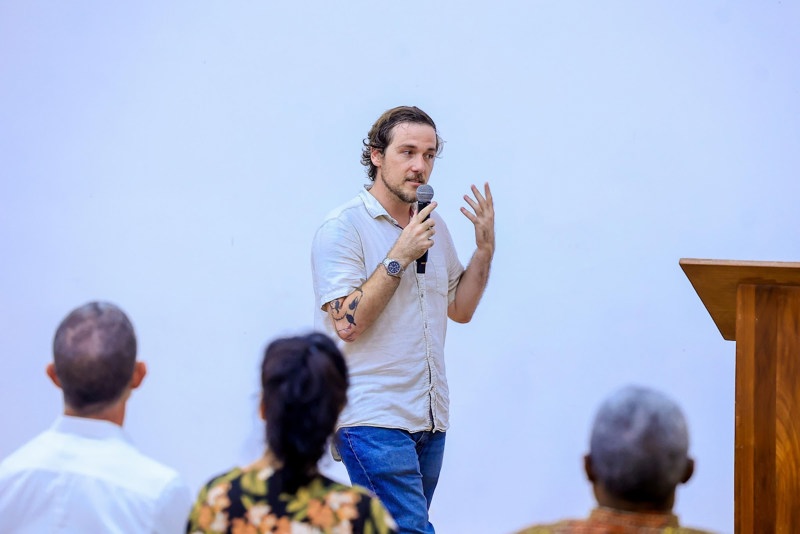
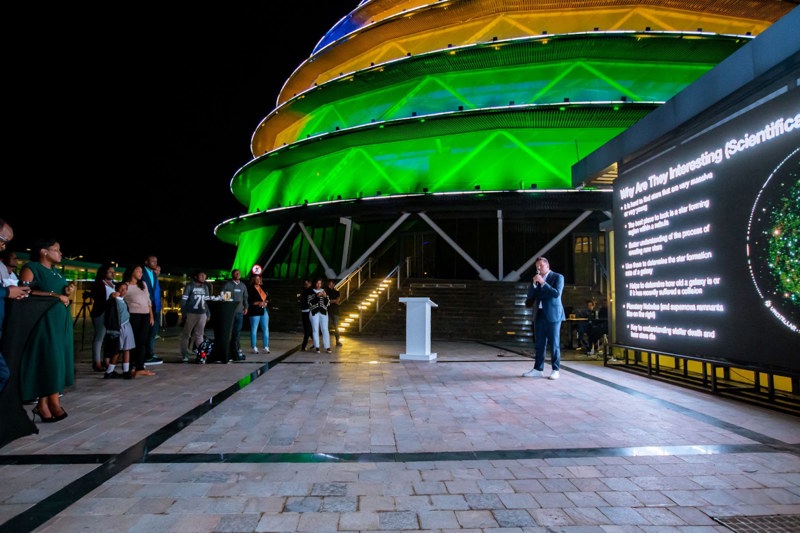
Dr. Lambert speaking at RICA (Credit: RICA)
Day One: RICA - Inspiring Sustainable Thinkers
The journey began at the Rwanda Institute for Conservation Agriculture (RICA), a unique college in Eastern Rwanda dedicated to sustainable farming practices. Although clouds blanketed the sky, preventing any direct stargazing, the team had prepared for this possibility. With images captured through the Unistellar ODYSSEY from previous observing sessions, Dr. Lambert introduced students to cosmic phenomena and delved into the science behind nebulae, star formation, and galaxies. Each picture became a teaching tool, sparking curiosity for participants and illuminating the possibilities of the night sky. Despite the weather, the students’ enthusiasm made the event memorable.
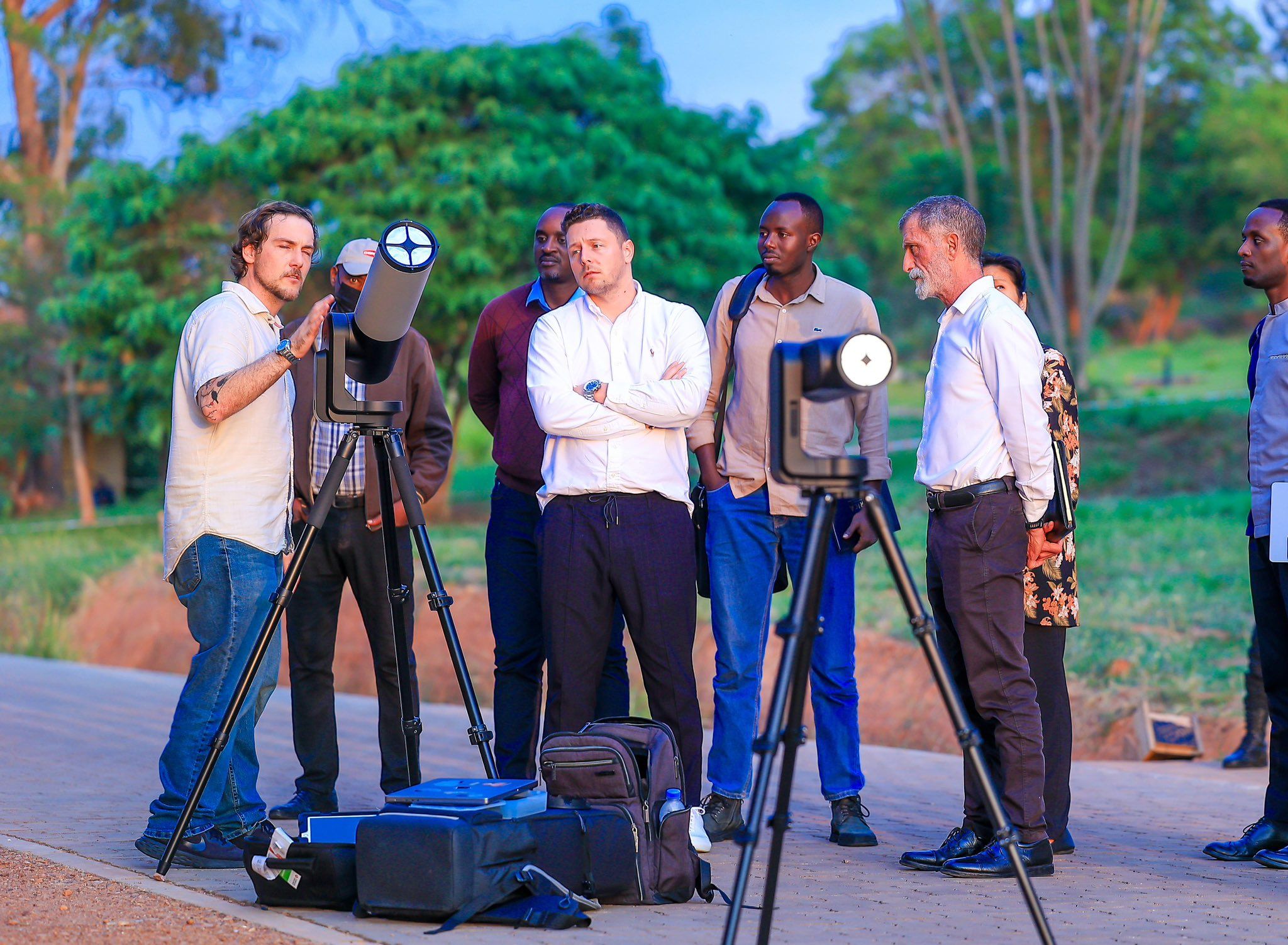
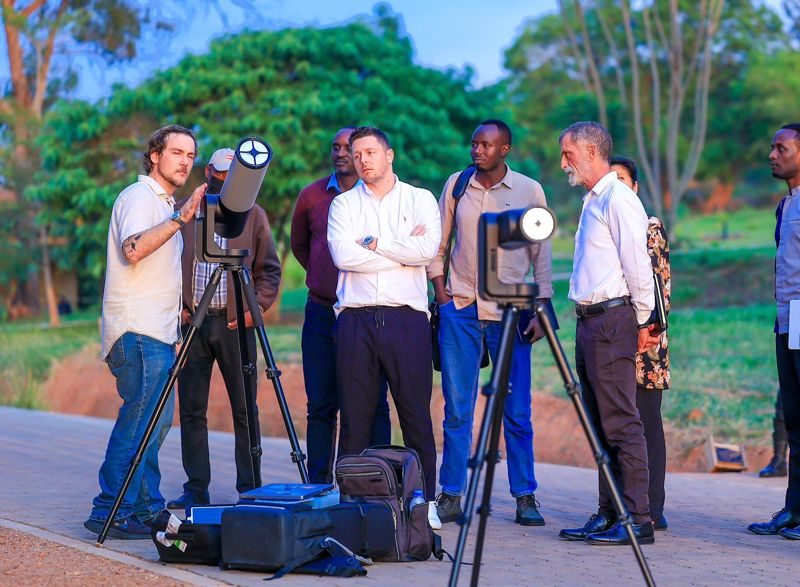
A group with TRL Space RW (Rwanda), TRL Space CZ (Czechia) and RSA looking at the Sun through the Unistellar EVSCOPE2 and ODYSSEY under the guidance of Dr. Lambert. (Credit: RICA)
Day Two: Rwanda Coding Academy - The Moon and Beyond
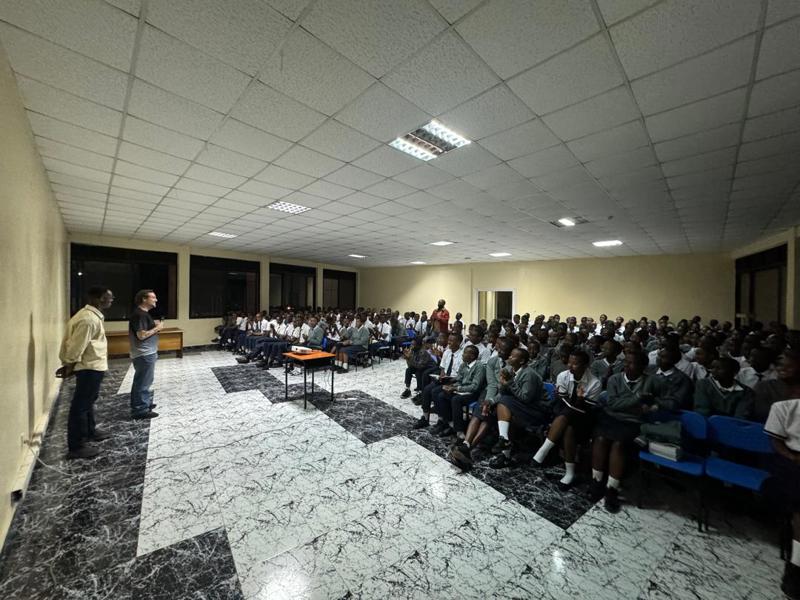
The next day took the team to the Rwanda Coding Academy, where tech-focused students awaited the opportunity to explore the universe. They managed a brief glimpse of the moon before the clouds took over, but the students’ interest remained unfettered as Dr. Lambert turned the session into an educational opportunity. With an audience of around 60 students, he discussed star-forming regions, planetary nebulae, and the lifecycle of stars, wrapping up with a Q&A that allowed students to dive deeper into the universe's mysteries.
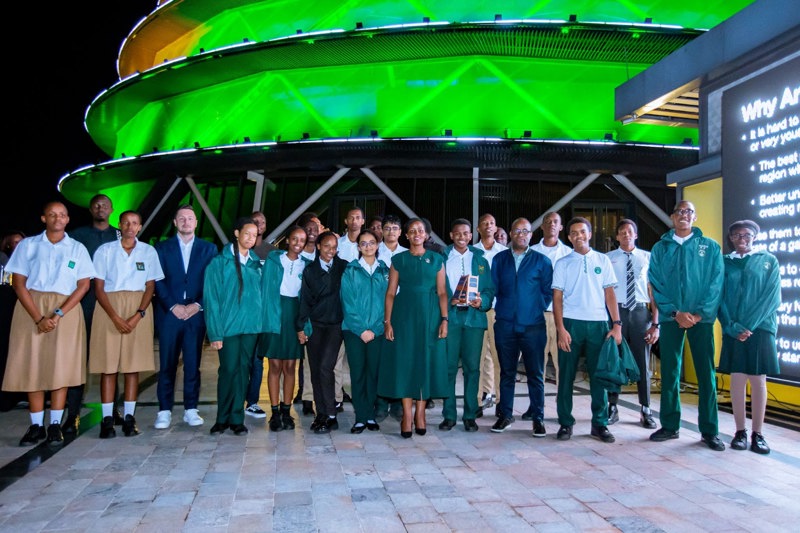
The celebration atop the Kigali Convention Center, celebrating the students for their efforts in the satellite-building competition. TRL Space, RSA, and Unistellar spokespersons were all in attendance to make the evening special. (Credit: Serge Tuyihimbaze)
Day Three: Preparing for the Satellite Challenge
The third day was dedicated to preparations for a grand finale — an exciting, hands-on satellite-building competition for high school students. TRL Space organized a live-streamed competition with three local high school teams, challenging them to build and present their own CubeSat prototypes. Each team brought their creativity and technical skills, building towards a chance to attend a final event on the rooftop of the Kigali Convention Center.
Day Four: Star Party and Celebrations in Kigali
The concluding day was a celebration of innovation and astronomy. After the competition, the winning team joined Dr. Lambert and TRL Space on the Convention Center rooftop for an evening event, which included a stargazing session and awards from the Chief Executive Officer of the RSA. Once again, the clouds had other plans, but the event turned into a virtual star party with Unistellar Citizen Astronomers joining the livestream from around the world. They shared real-time observations from their Unistellar smart telescopes, allowing the attendees to experience live astronomical viewing, despite the weather.
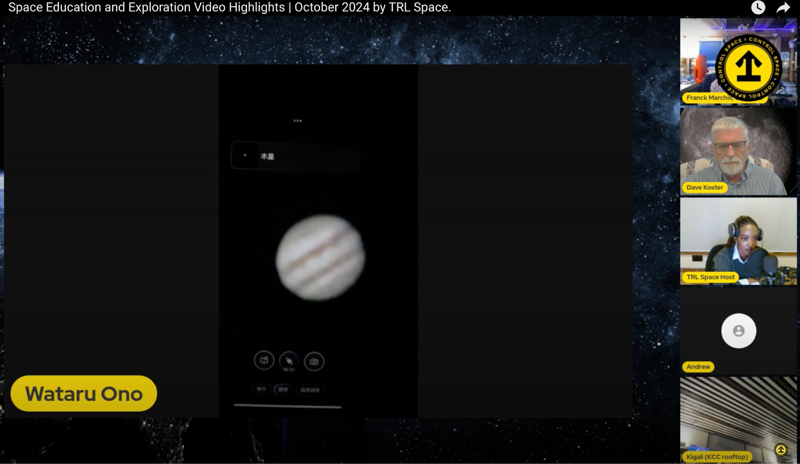
During the livestream, Unistellar Citizen Astronomers Wataru Ono (Japan) and Dave Koster (US) shared live observations through their telescopes. Here you can see Wataru showcasing Jupiter! Afterwards, Dr. Marchis gave a virtual presentation. (Credit: TRL Space RW)
A Journey to the Stars
“Rwanda was my first experience in the African continent and I can't wait to go back,” said Lambert. “Everyone was very welcoming (I was even given souvenirs!) and the work they are doing to bring space science to their communities is truly inspiring.”
Now, TRL Space has access to Unistellar technology, so the future of stargazing in this country can reach new heights.
“With the power of digital telescope technology and our citizen science program, students and educators can explore the universe in unprecedented ways,” Marchis stated. “As Rwanda prepares to launch the first satellite made in Rwanda into space, we are proud to contribute to this historic journey by enabling real-time observations of the satellite with Rwanda’s own telescope, fostering inspiration and deeper connections with space.”
International Space Week in Rwanda highlighted the power of collaboration and the unifying curiosity that astronomy brings. From discussions on sustainability to high-tech satellite projects to deep-sky objects, this journey celebrated the interconnectedness of humanity, Earth, and the stars to leave a lasting impression on a new generation of space enthusiasts.
SkyMapper and the SETI Institute are connecting educators, students and the public to live astronomical observations through a distributed astronomical network.
#SkyMapper
#SETI
#Citizen Science
#Astronomy
What happens if life beyond Earth is discovered? The Discovery and Futures Lab at the SETI Institute fosters novel and anticipatory research at the intersection of science, society, our planet, and the search for life beyond Earth.
#Discovery and Futures Lab
SkyMapper and the SETI Institute are connecting educators, students and the public to live astronomical observations through a distributed astronomical network.
What happens if life beyond Earth is discovered? The Discovery and Futures Lab at the SETI Institute fosters novel and anticipatory research at the intersection of science, society, our planet, and the search for life beyond Earth.
Scientists are getting closer in their search for life beyond earth. But with limited federal funding for the search for extraterrestrial intelligence, supporters are the reason cutting-edge scientists can keep their eyes on the sky.
)