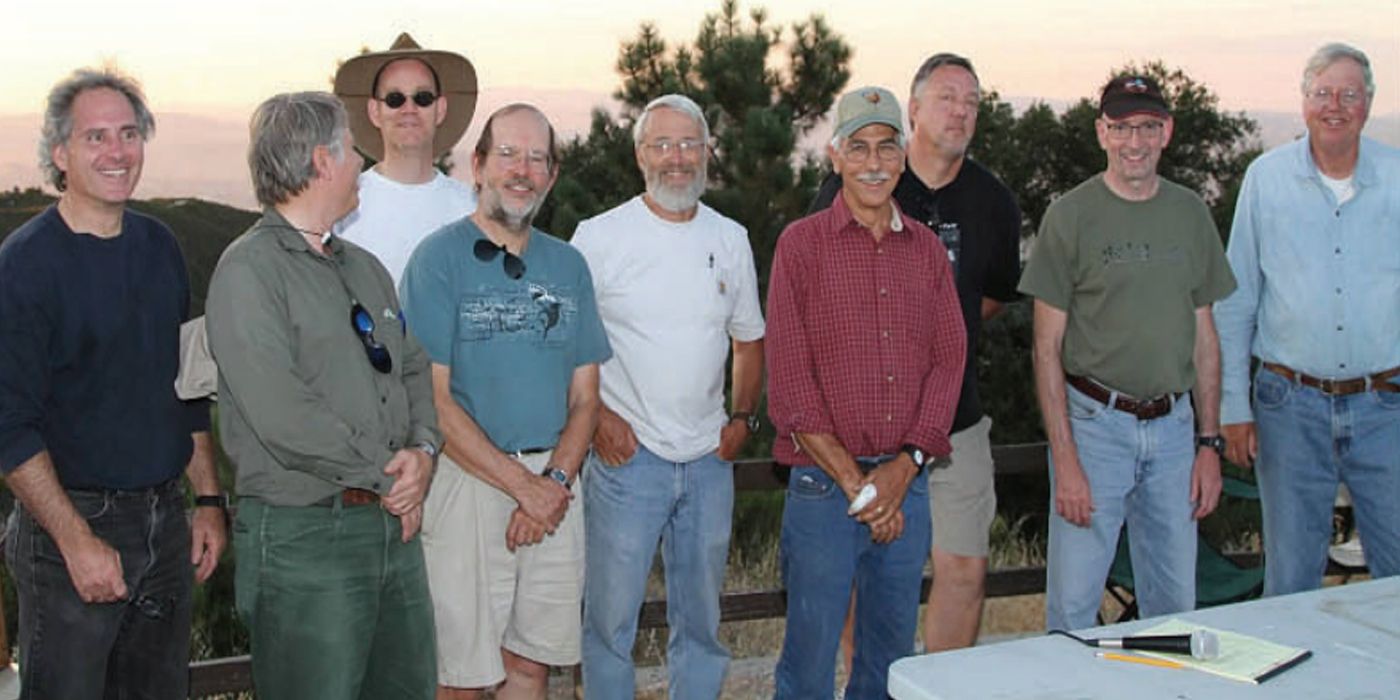





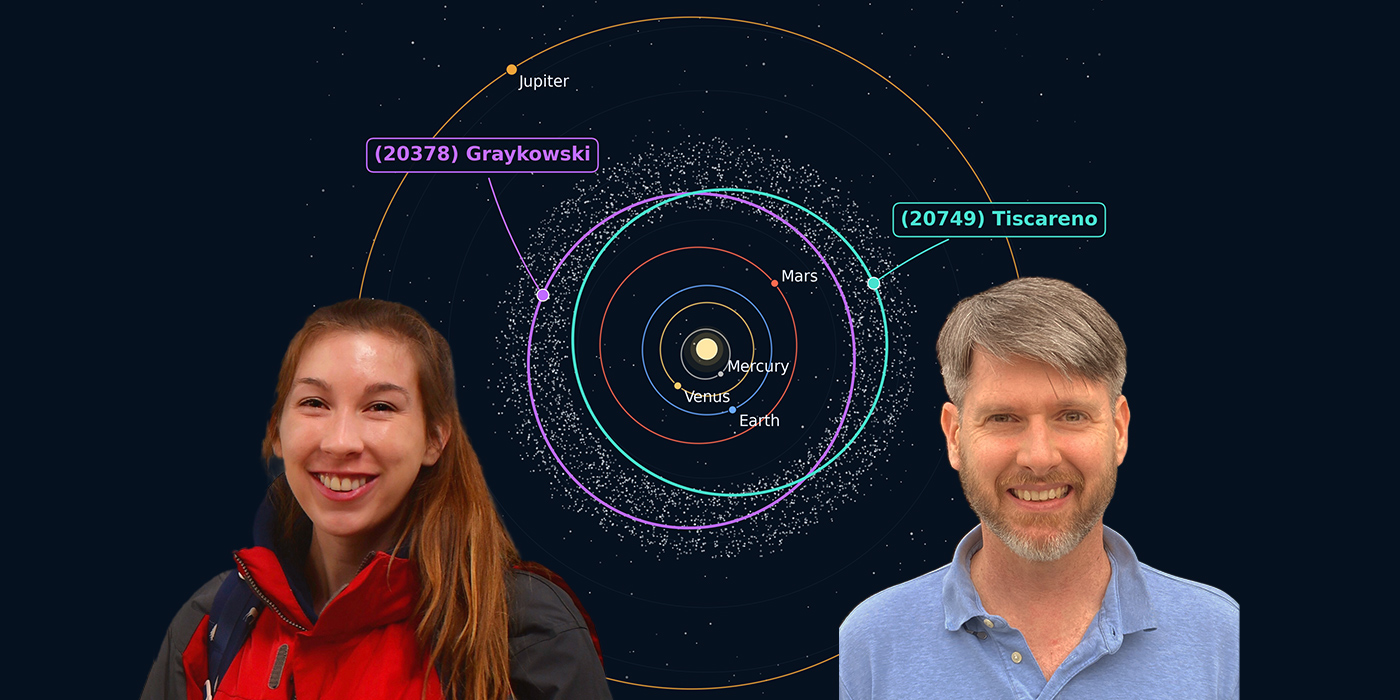

One of the recipients honored is Dave Samuels, left in this 2012 photo with other citizen scientists who established the first CAMS station at Fremont Peak Observatory (FPO) in California. Dave has continued to support the daily operations of what had since grown into an international CAMS network. From left to right are former and current FPO Association board members Dave Samuels, Chris Angelos, Michael Connally, Rob Hawley, Ron Dammann, Rick Morales, John Parker, Doug Brown, and Loren Dynneson. Image Credit: www.fpoa.net.
Last week's batch of names adopted by the IAU for some of the asteroids in our solar system included several people who, for almost a lifetime, have been active amateur meteor astronomers in the USA, Netherlands and Belgium. Some of these citizen scientists were honored particularly for their long-time participation in the SETI Institute's Cameras for Allsky Meteor Surveillance (CAMS) project.
CAMS is an international project providing low-light video surveillance of the night sky that aims to map our meteor showers and detect unusual activity. CAMS is a NASA-sponsored initiative led by Dr. Peter Jenniskens of the SETI Institute.
In our solar system, there are over one million known asteroids, small rocky objects, with most of them orbiting the Sun between the orbits of Mars and Jupiter. The debris from some of these asteroids can be perturbed out of the asteroid belt and cause meteors here on Earth. These celestial bodies offer valuable insights into the formation of our solar system and hold clues to Earth's history, including the origin of its water, information obtained from the surviving meteorites that fall to the ground.
How do these asteroids receive their names? The International Astronomical Union (IAU) has overseen this process since the early 20th century. When someone reports the discovery of a new asteroid to the IAU, it is assigned a temporary name to prevent duplicate discoveries. The discoverers, in this case the 1993–2008 LONEOS asteroid survey program run out of Lowell Observatory, can then propose a permanent name with a few naming restrictions (naming asteroids after pets is discouraged, for example). Lowell Observatory astronomers are participating in the CAMS project.
The IAU's Working Group Small Bodies Nomenclature officially announced the newly accepted names in the IAU Working Group for Small Bodies Nomenclature Bulletin of 2023 October 16. The new asteroid names are: 38639 (Samuels), 38642 (Breukers), 38643 (Scholten), 38667 (de Lignie), 38823 (Nijland), 38827 (ter Kuile), 38828 (Van 't Leven), 38829 (Vandeputte), 38830 (Biets), and 38967 (Haas). Congratulations to these citizen scientist enthusiasts for their recognized contributions to meteor shower research.
CAMS project: https://meteorshowers.seti.org
To find information on the citations, enter the asteroid number here: https://cneos.jpl.nasa.gov/
News
Related News
Beyond Disclosure Day: The Real-World Protocols
#Press Releases #SETI #Astronomy #Bill Diamond #SETI Institute
SETI Institute In the News: May Roundup 2026
#SETI Institute in the News #SETI Institute #Community #Solar System #Matija Ćuk #Neptune #SETI #Bill Diamond #UAPs #Drake Awards #Lori Marino #Matthew Tiscareno #Outreach #Exoplanets #Carl Sagan Center
SETI Institute Awards $1 Million in STRIDE Grants to Advance Astrobiology, Exoplanet Science, and Public Engagement
#Press Releases #STRIDE #Research #Carl Sagan Center #Spectroscopy #Solar System #SETI #Climate and Bioscience #Astronomy #Astrobiology #Exoplanets #Data Science #Education #Outreach #Hat Creek Radio Observatory #Unistellar #SkyMapper
Asteroid Named in Honor of SETI Researcher and Communicator Seth Shostak
#Comets, Meteors, and Asteroids #Seth Shostak #SETI #Astronomy #Big Picture Science #Outreach #Andrew Fraknoi
Narrowing the Search: The 45 Best Targets for Alien Life
#Blog #Astronomy #JWST #NASA Missions and Observatories #Trappist-1 #LaserSETI #ATA #Franck Marchis
Rethinking Organics on Mars
By Nathalie A. Cabrol, Director of the Carl Sagan Center for Research, SETI Institute #Mars #Astrobiology #Solar System #Curiosity Rover #NASA Missions and Observatories #Nathalie CabrolResearch
Related Projects
SkyMapper: Expanding Access to Real-time Astronomy Through a Global Astronomical Network
SkyMapper and the SETI Institute are connecting educators, students and the public to live astronomical observations through a distributed astronomical network. #SkyMapper #SETI #Citizen Science #Astronomy
Virtual Planetary Laboratory
How can we best assess whether an exoplanet supports life? #VPL
Discovery and Futures Lab
What happens if life beyond Earth is discovered? The Discovery and Futures Lab at the SETI Institute fosters novel and anticipatory research at the intersection of science, society, our planet, and the search for life beyond Earth. #Discovery and Futures LabSupport the
SETI Institute
Scientists are getting closer in their search for life beyond earth. But with limited federal funding for the search for extraterrestrial intelligence, supporters are the reason cutting-edge scientists can keep their eyes on the sky.